Generator Enclosure: Open vs Silent vs Containerised — How to Choose for a UAE Site
Price a "500 kVA silent generator" off the supplier list and you may be buying a July breakdown. The enclosure is the generator's second operating environment — and the site, not the word "silent", decides it.

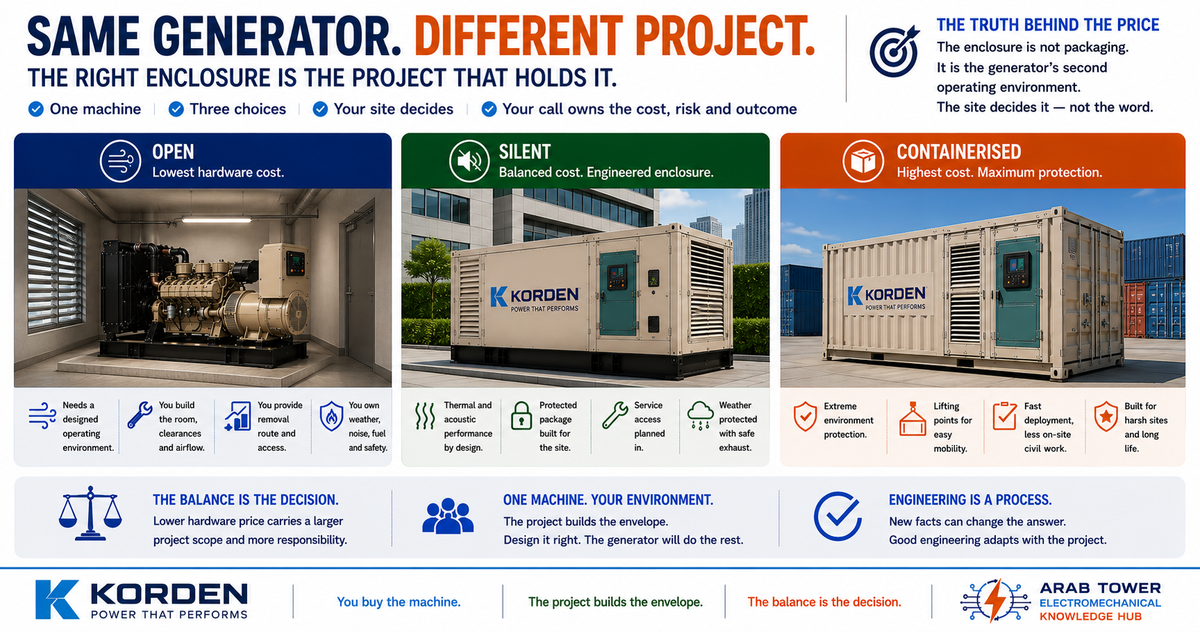
Generator suppliers usually quote three versions of what can be the same electrical generator — open, silent, and containerised. The engine and the alternator can be identical in all three. What changes is everything around them — and that is what separates the prices, and decides where the set can stand, how much noise reaches the neighbours, whether it holds its power on a hot afternoon, whether it can be moved later, and how much of the job lands on you.
This guide explains when each one is the right choice for your site. Read the two you're weighing up; there's a side-by-side comparison and a short "before you order" at the end.
One idea runs through all of it: it's the same generator — what changes is everything around it. With an open set, you build that "everything." With a silent canopy, most of it arrives already built. With a container, it becomes a project of its own. Match it to your site and the generator does its job without drama; get it wrong and you lose power on the hottest day, draw a noise complaint, or pay for a room or a crane nobody planned for.
Open — why is it so much cheaper?
Put three quotations side by side and one is always the lowest — the open set. Before you take it, it's worth asking what that lower number is actually telling you.
An open generator is the bare machine on its steel base: engine, alternator, controls, and nothing else. No sound-proofing, no weather skin, no built-in air path. So the price is honest — you are paying for the generator, and only the generator. What it doesn't tell you is where the rest goes.
Because the rest doesn't disappear. Everything a canopy would have carried — cooling airflow, heat rejection, the exhaust and its silencer, noise control, weather and dust protection, room to service it and lift it out again, fuel and fire coordination — still has to exist. It simply moves onto your side of the fence. An open set doesn't come without an operating environment; it comes without one built in — and now you build it: a room, or another properly engineered protected installation, sized to feed and cool the engine at your site temperature.
Do that well and the open set quietly rewards you: the best service access of the three, the lowest hardware cost, and a set that holds its rating because you — not a fixed factory louvre — control the air it breathes.
Do it badly, or not at all, and the cheapest machine becomes the most expensive decision. The story is familiar — an open set bought on price for a site with nowhere compliant to put it, then squeezed into an improvised, half-ventilated room where it runs hot and gives up power, or left in the open where the first person it meets is an unhappy neighbour. The money saved on the machine comes back out, several times over, as civil work, a hired set, or a complaint.
So open is the right answer in one situation: when you already have — or genuinely want to build — a proper engineered room, or when the set is large or runs long enough that it belongs in one anyway.
And that is exactly why most buyers hesitate. Building all of that is a project in itself. What if the generator could simply arrive with its environment already around it — quiet, weatherproof, standing outside, ready to run? It can. That is the silent canopy, and it is the most common answer for a reason. So can you just buy one and forget about it?
Silent — can you just buy it and forget it?
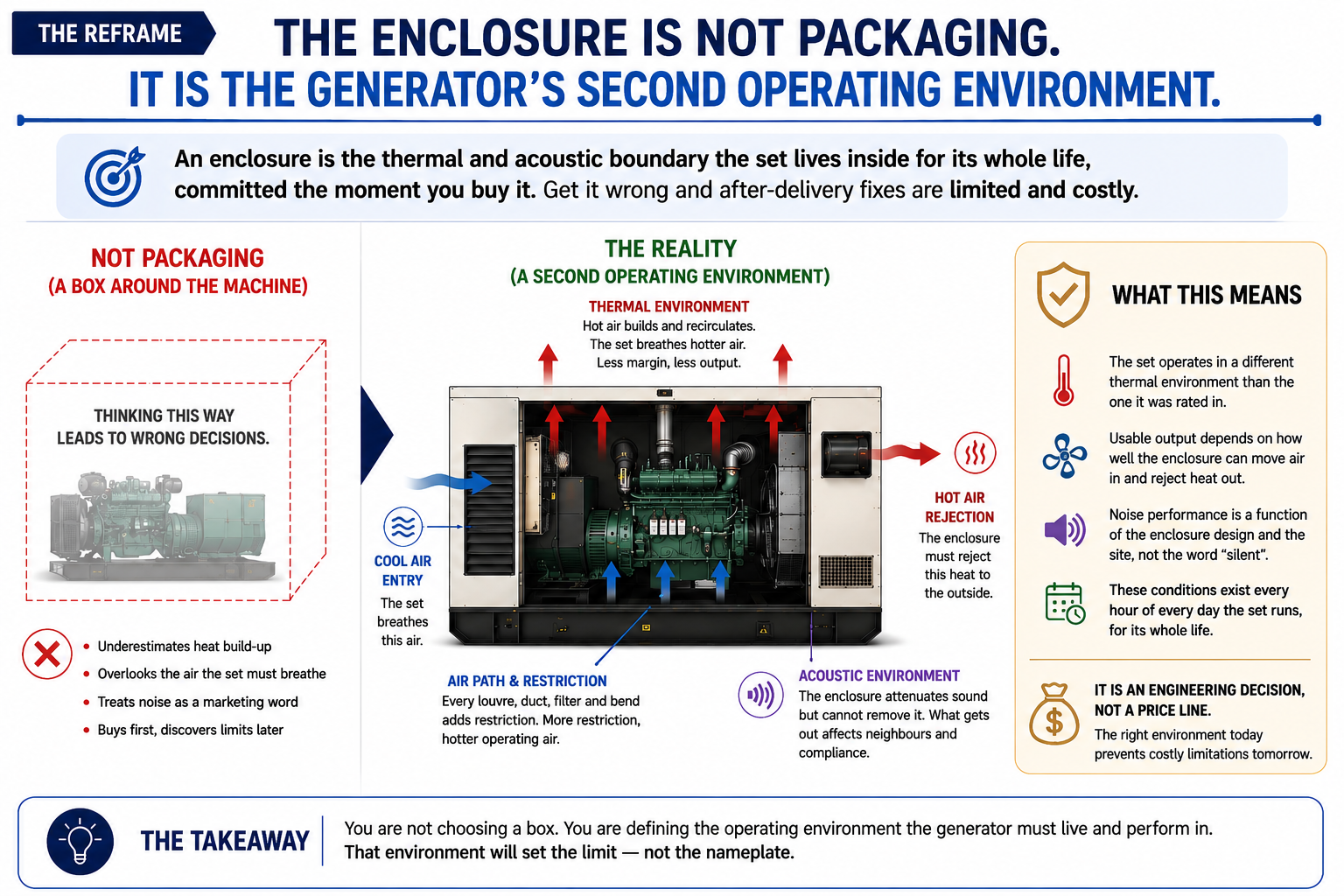
Almost. And for a great many UAE sites that really is the right move — which is why the canopy is so often chosen. But "silent" is a sales word, and the two things it quietly leaves out are where most of the trouble starts.
What the word hides — heat. A canopy has to do two opposite jobs at once: hold the noise in, and let a very large volume of cooling and combustion air through. The acoustic louvres, baffles, fan, radiator and discharge path all add resistance — and if they are poorly matched, or the hot discharge finds its way back to the intake, the air inside the box climbs above the yard outside. A generator makes less power as the air it draws gets hotter, so a canopy that passed a cool factory test can fall short on the one hot afternoon you bought it for. You can't see this on a datasheet. The single line that protects you: make the supplier guarantee the enclosed package's output at your site temperature, in writing.
What the word hides — "how quiet, exactly?" "Silent" means quieter, not silent, and a noise figure with no distance is marketing, not data. Ask for the sound level at a stated distance and check it against your boundary limit — next to a hospital ward or a residential wall, a standard canopy may still need extra attenuation.
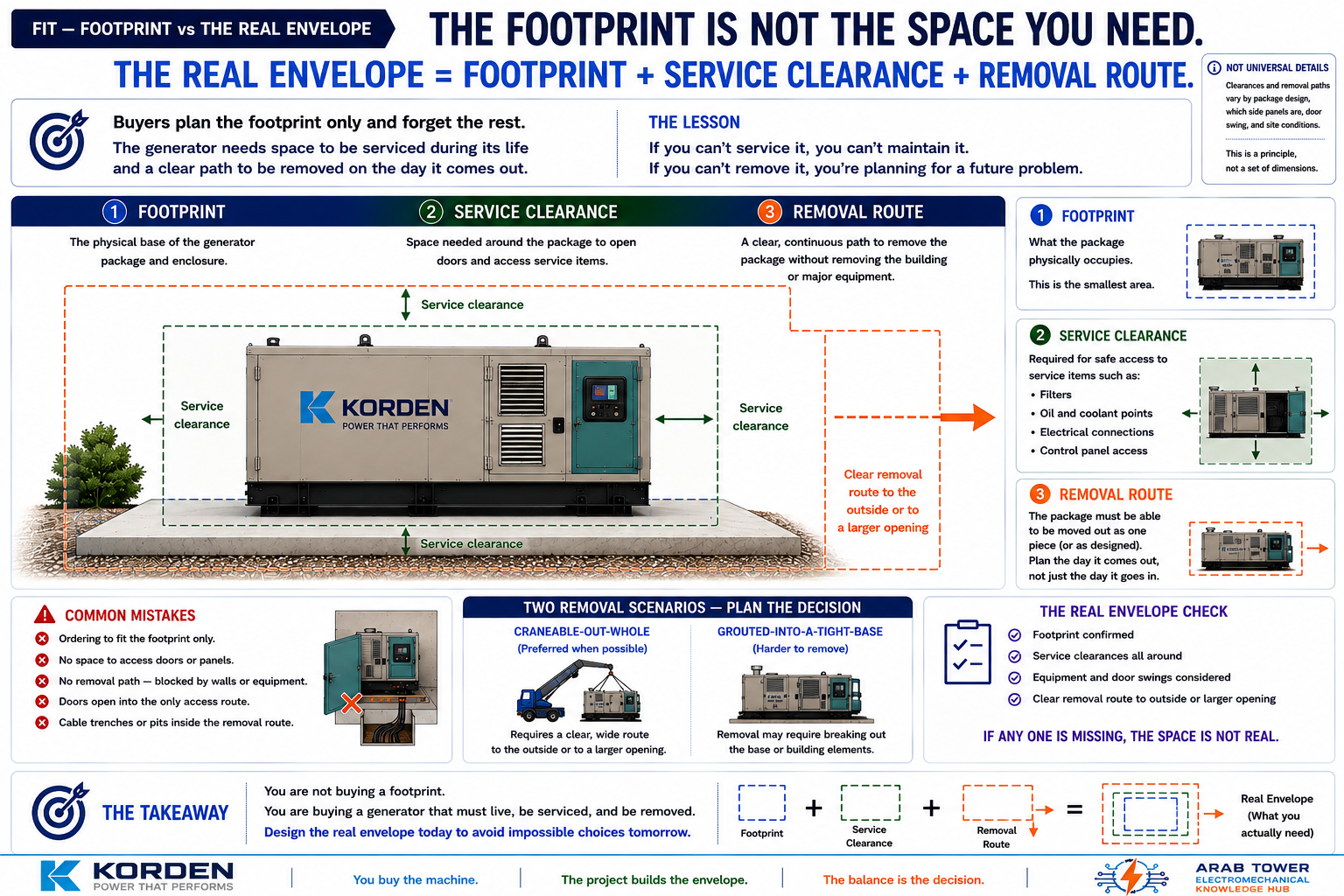
generator-enclosure-selection-03-dba-needs-a-distance.pngAnd the ordinary things it doesn't remove. A canopy still needs a sized foundation and clearances, an exhaust arrangement, and drainage. "Self-contained" means "no separate room" — not "no installation."
The engineering, made simple (for the technical reader — illustrative figures; use your selected machine's real data):
A guardrail first: this assumes the electrical sizing has already fixed the package you need — say 500 kVA. Starting loads, transients, non-linear loads and duty are the sizing job, not the enclosure job. Here we only check that the enclosure can deliver that output on site.
- Required output: the already-sized package — for example 500 kVA.
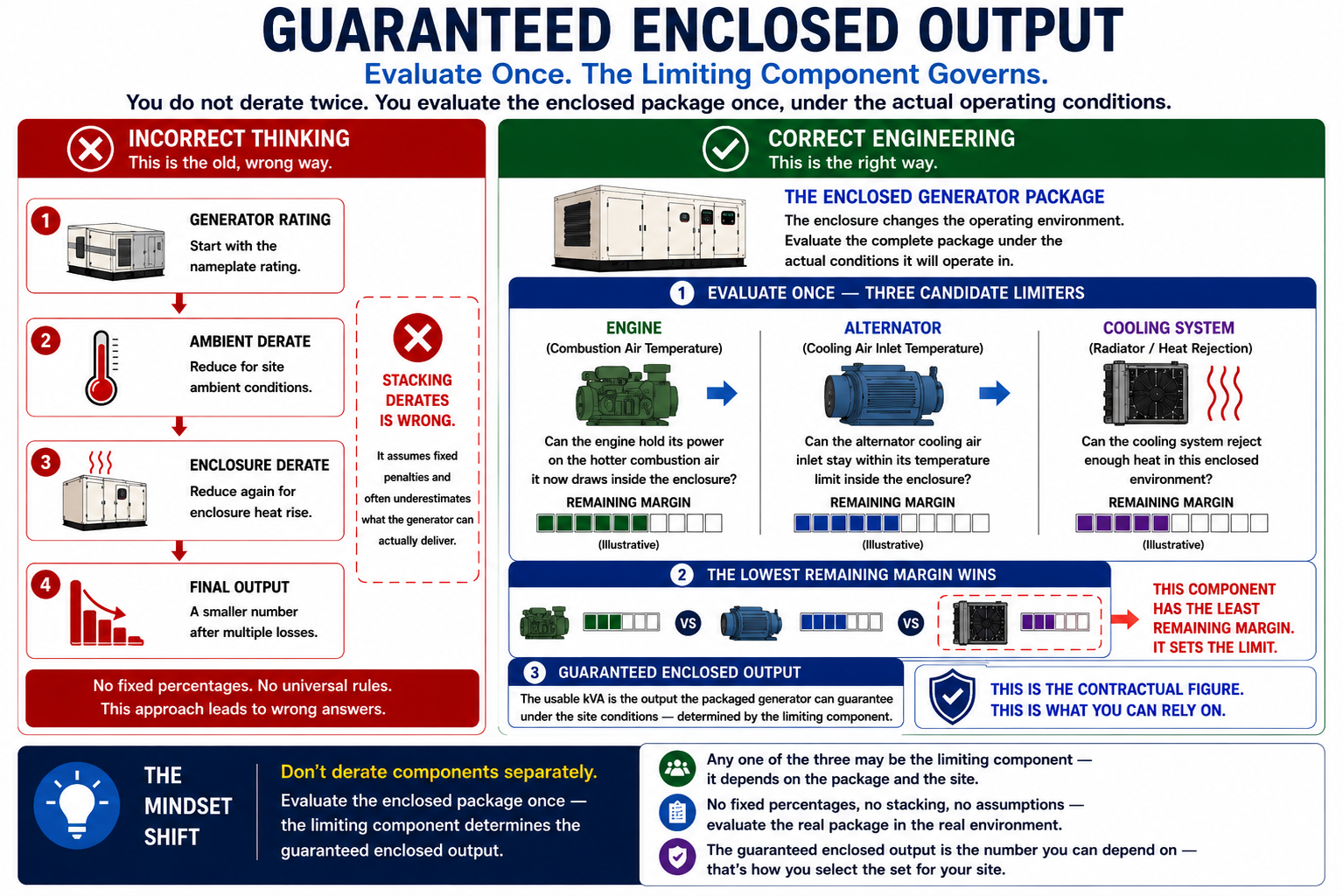
- Manufacturer ratings are published at stated reference conditions. Your site ambient — and the air temperature at each component's intake or cooling point — may be higher.
- Inside a canopy on a hot day, the air sits above the yard by an amount that depends on the fans, louvres, layout and any recirculation — so it is measured or guaranteed, not assumed.
- You don't add the losses up. Each part — the engine at its air intake, the alternator at its cooling-air inlet, the cooling system's ability to reject heat — is checked at the hotter air it actually draws, and the one with the least margin sets the real output.
- If the guaranteed output at your ambient is below your load, the answer isn't to guess a fix — it's to require the supplier to guarantee the required output at your stated ambient and installation conditions. Whether they get there with a different radiator, fan, louvre, discharge path, larger enclosure or a bigger machine is theirs to decide and warrant.
So — can you buy it and forget it? Almost. A canopy is a genuinely good answer for outdoor standby — once you've made the supplier prove the output at your heat and state the noise at a real distance. Those two questions turn "silent" from a word into a specification.
For most standby projects, that is where the decision ends. But sometimes even a well-made canopy isn't enough — the job has grown past a single quiet set. That is when people pay for a container.
Containerised — why would anyone pay even more?
If a proven canopy already answers most sites, the container is a puzzle: it is the dearest of the three to buy, and then it asks for a crane and a foundation on top. Somebody is choosing it on purpose. What do they know?
Start with what it isn't. A container is not a canopy with thicker walls, and buying one for toughness alone is money spent on reassurance. You reach for a container when the job has quietly stopped being about a single quiet generator and become a power project — and three things tend to be what tip it over.
The first is duty. A set that runs a few hours a month is a different animal from one that runs long, hard hours — prime or continuous. Long running wants fuel autonomy, cooling margin and robustness, and a container is built to carry them.
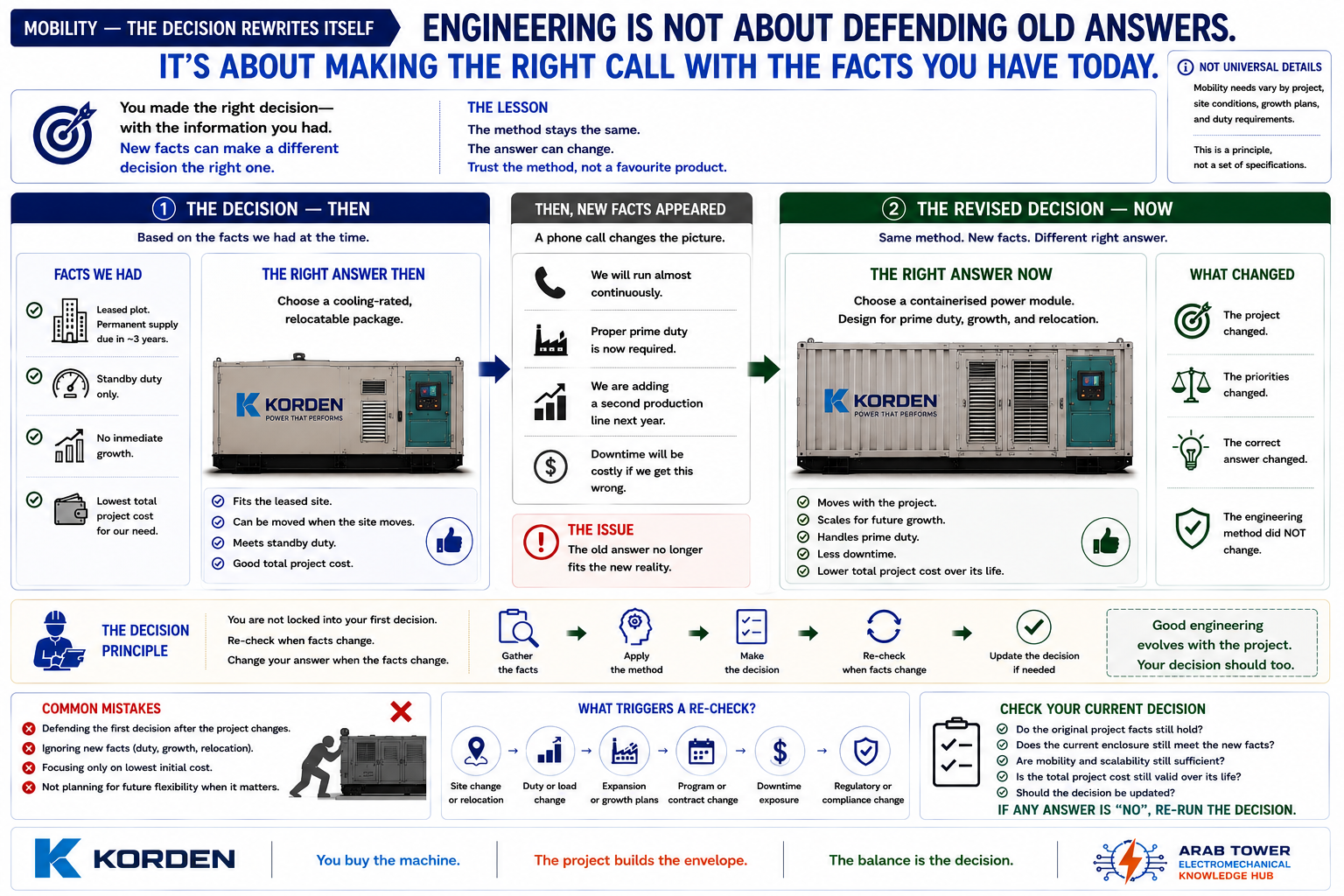
The second is movement. A leased plot, a temporary supply, a site built in phases — any of these means the set may not stay where you first put it. A container lifts onto a truck and goes; a set grouted into a plinth stays, and comes out only by breaking it free.
The third is growth. If the load will climb, a container lets you add and parallel more modules rather than replace the set you have — provided you treat paralleling as the real engineering it is: synchronising, control, protection, load-sharing and fuel, not simply parking two boxes side by side.
None of it is free, and none of it is automatic. A container is only as relocatable, as expandable, and as well-cooled as it was designed to be — so the one line that protected you on the canopy protects you here too: guarantee the output, and the capability, at your conditions.
So the honest answer to "why pay more?" is this: you are not buying a sturdier box, you are buying a strategy — for duty, movement or growth that a canopy cannot carry. And if your site has none of those, the extra money buys you something you will never use. Which is exactly the point of putting the three side by side.
generator-enclosure-selection-06-decision-rewrites-itself.pngThe three, side by side
By now the difference isn't really "cheap, medium, expensive" — it's how much of the operating environment each one brings, and how much it leaves to you.
| Open (skid) | Silent (acoustic canopy) | Containerised (module) | |
|---|---|---|---|
| What you're buying | the machine only | the machine + its environment, built in | the machine as part of a power module |
| Who builds the room / air path | you (a designed room or protected install) | comes built — but prove it for your heat | comes built, with more room and integration |
| Noise at the boundary | highest — the room must control it | low — built in, stated at a distance | low — built in |
| Holding power at 50 °C | you control the air, so you can | only if the enclosed output is guaranteed | only if designed and guaranteed for it |
| Service access | best (all sides) | can be tight | good (often walk-in) |
| Moving it later / growing | fixed in its room | movable as a unit | craneable; parallels and scales — if designed to |
| Hardware price | lowest | middle | highest |
| Fits best when | you have or want a proper room | outdoor standby, no room | long duty, moving or growing sites |
The prices differ because the projects differ — three different amounts of "everything around the generator," for three different sites.
Before you order
The decision was never really open, silent or container. It was what your site needs around the generator. Before you sign a quotation, make sure you can answer these — they're what separate a right choice from an expensive one:
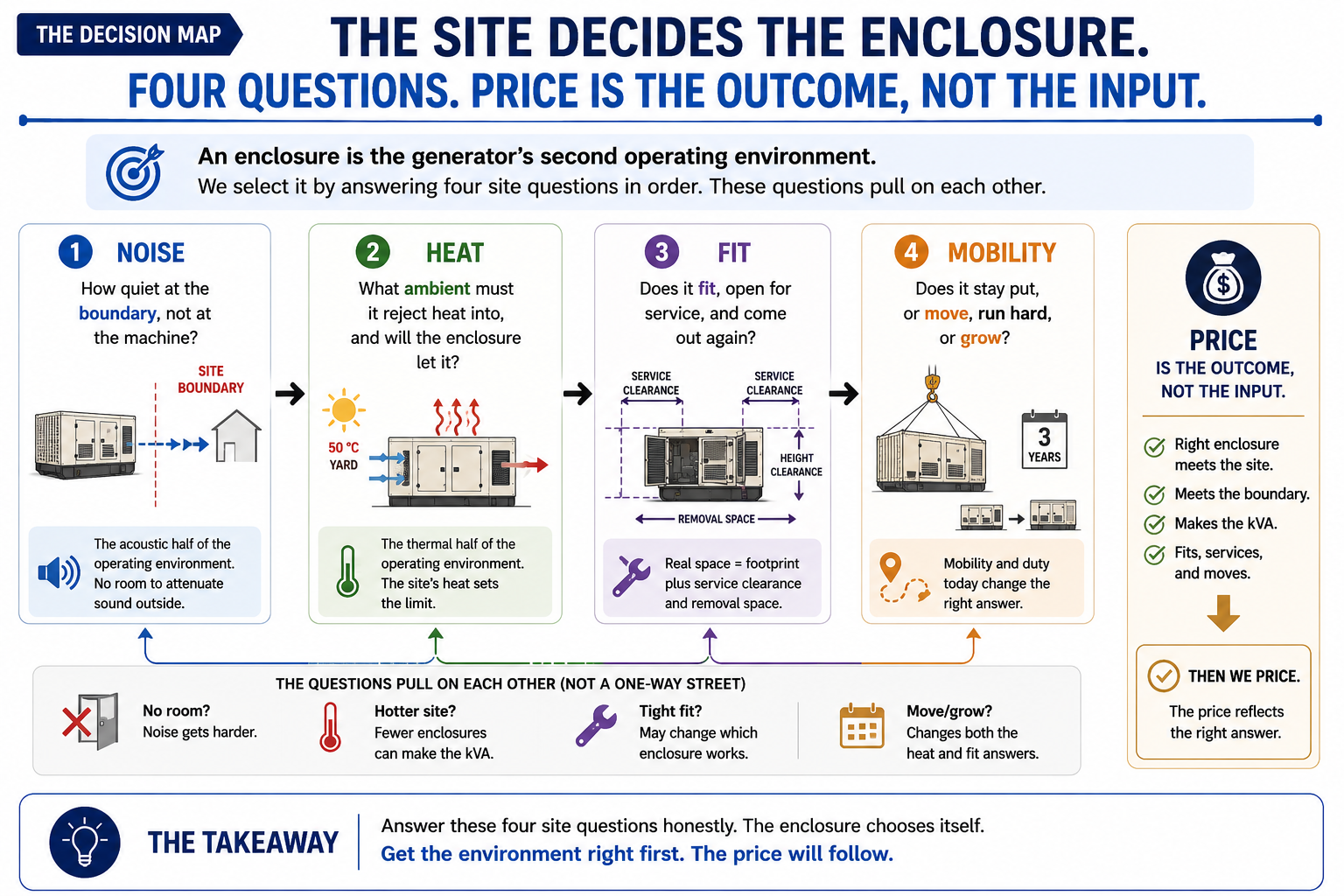
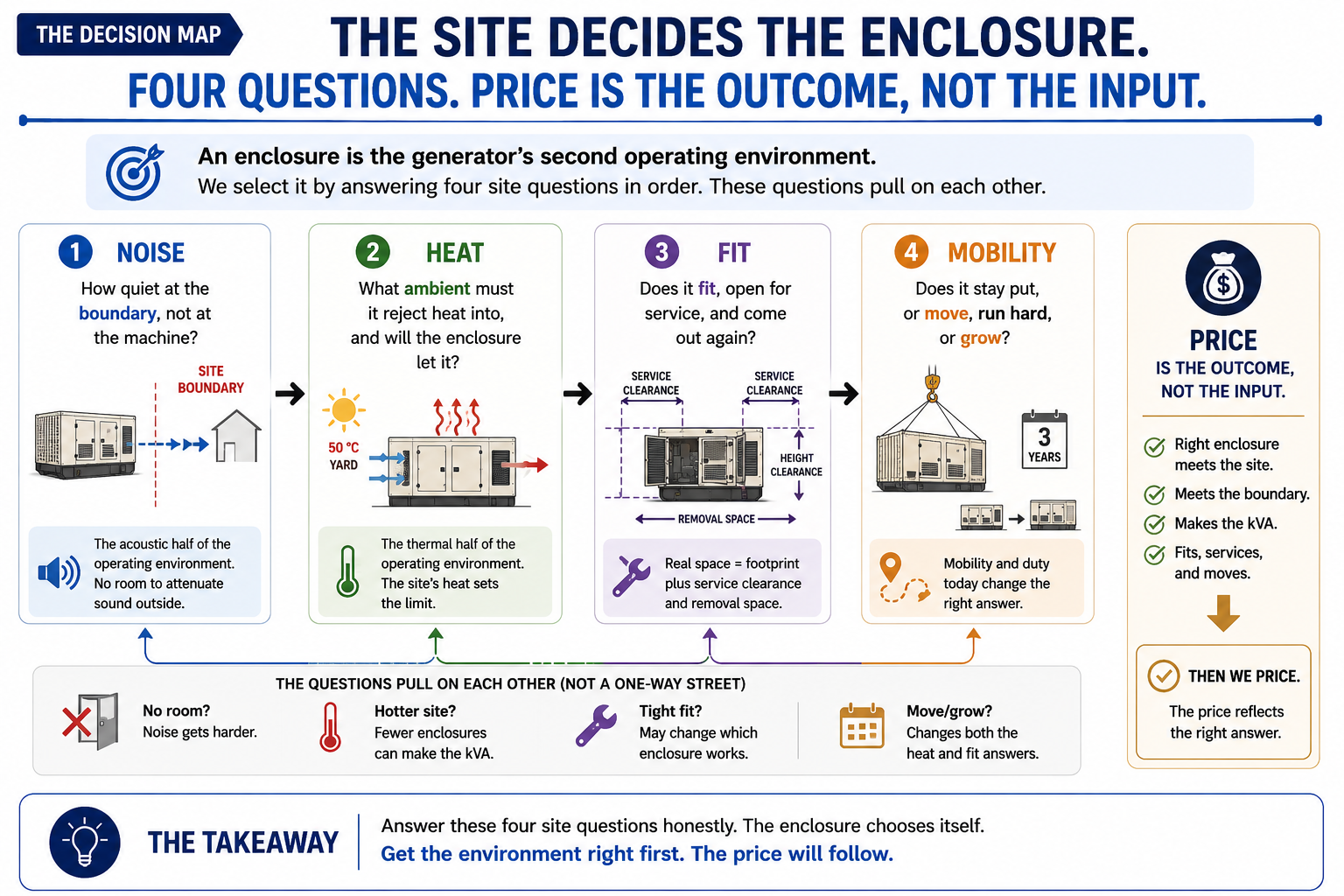
generator-enclosure-selection-02-four-site-questions.png- Where will it stand — is there a room, or the space and budget for one? No room, and open stops being the cheap option: it drags a whole room behind it.
- How close is the nearest occupied building, and what noise level does the site allow, at what distance? A dB(A) with no distance isn't an answer.
- What is your site's design temperature — and for a canopy or container, is the enclosed output guaranteed at that temperature, in writing? Not the open-set rating.
- Will the set ever move, run long hours, or grow? If yes, weigh a container against a second installation later, not against the canopy today.
- Whatever the form — is the fuel arrangement and the Civil Defence approval accounted for?
Answer those and the three quotations stop reading as "cheap, medium, expensive," and start reading as what they are: different amounts of project, for different sites.
If you'd like a second set of eyes before you commit, tell us four things — the boundary noise limit and how far the nearest occupied building is; your site temperature and where the set will stand; the space and access you have; and whether it must move or run continuously later. We'll tell you which form your site actually needs, confirm the rating survives your heat, and — if the answer is an open set — what the room then has to do. Arab Tower supplies, installs, tests and commissions generator sets and their enclosures across the UAE and internationally.
Talk to our engineers → · or see our diesel generators.
Go deeper: sizing comes first — see Generator Sizing. Choose an open set and the room is next — see Generator Room Design. For the depth behind the screens here, see Generator Fuel Systems & Civil Defence; Generator Noise Control and Common Generator Installation Failures publish soon.
Engineering references
- ISO 8528-1 — generating-set ratings, site reference conditions, and standby (ESP/LTP), prime (PRP) and continuous (COP) duty definitions.
- ISO 8528-10 — genset airborne-noise emission descriptors (sound power and emission sound pressure); boundary compliance is a separate propagation assessment (ISO 9613-2 or the authority's method — see Generator Noise Control).
- ISO 3046 — engine reference conditions and derating for temperature.
- IEC 60529 — degrees of protection (IP code) for dust and water ingress (not corrosion or UV).
- ISO 12944 — atmospheric-corrosivity categories and protective-coating systems, for the coastal/UV protection the IP code does not cover.
- NFPA 110 / NFPA 37 — standby power and stationary combustion-engine installation (the open-set room context; see Generator Room Design).
- UAE Fire and Life Safety Code of Practice (Civil Defence) — outdoor fuel storage, separation and generator approval.
- Manufacturer application and rating data (engines and alternators) — for the model-specific derate factors and the guaranteed output at site ambient and inside the enclosure.