Generator Sizing: How to Size a Diesel Generator for a UAE Building
Two engineers, same building, two very different generator sizes — both defensible. This guide walks the decisions that set the number: ratings, load schedule, step loads, 50 °C derating and special loads, with one worked example.

Two engineers, same building. You hand them the same drawings and the same load schedule and ask each one to size the standby generator.
One comes back with 800 kVA. The other, just as experienced, says 1250. Neither has made a mistake you could circle on the calculation sheet, and both will happily defend their number.
That is a 50-plus percent difference on the same building — and if you have been doing this a while, you have watched exactly that argument play out in a design meeting.
So how do two good engineers look at the same loads and land that far apart?
Because "the load" is not one number, and neither is "the size." Sizing a generator is a short series of engineering decisions, and those two engineers made them differently. A generator is not sized by one calculation — it is sized by a chain of decisions, and the chain is only as strong as its weakest assumption. Walk through those decisions in order and your number stops being an opinion; it becomes something you can defend. That is what this guide does.
What will this guide settle — and what will it leave to other guides?
It settles enough to size a normal building correctly: what a generator "size" really is · kW, kVA and power factor · picking the rating · building the load schedule · the largest step · de-rating for 50 °C · special loads (UPS, motors, fire pump) · a worked example to a final number · a decision tree for other building types.
It deliberately does not cover (kept short and linked, so this stays one clear path): deep rating theory, full transient theory, the complete de-rating deep-dive, enclosure choice, room and fuel design, earthing and protection, and commissioning. Each has its own guide — go there when your project needs the detail.
When someone says "size the generator," what are they really asking?
Three questions, hiding inside one:
- What rating do you need? Standby, prime, or continuous — the duty decides how hard the set is allowed to work.
- Can it carry the running load, with headroom? The steady kW and kVA the building draws.
- Can it take the biggest step without the voltage caving in? The moment your largest motor or the fire pump starts.
None of the three is a lookup. Each is a decision. Miss one and you get a number that looks fine on paper and trips in the plant room — that is the whole disagreement between our two engineers. Get all three right and the number defends itself.
We will size one real building as we go, so each decision lands on something you can picture.
Our worked example: a mid-rise commercial building in the UAE — offices and retail, a basement car park, rooftop chillers, a fire pump, and a small server room on a UPS. Standby duty: the utility is there, and the generator backs up the building on a power cut. Ordinary on purpose — you will recognise your own project in it.
Step 1 — kW or kVA: which one are you sizing?
Both. That is the catch, and it is where most sizing arguments start, so let us settle it first.
- kW is real power — what the engine has to produce.
- kVA is apparent power — what the alternator has to produce.
- Power factor (pf) links them: kVA = kW ÷ pf.
A diesel generator is rated at 0.8 power factor — so a 1000 kVA set is a 800 kW set. The engine gives you the kW; the alternator gives you the kVA, and you have to satisfy both. Size on kW alone and you can run the alternator out of kVA; size on kVA alone and you can run the engine out of kW.
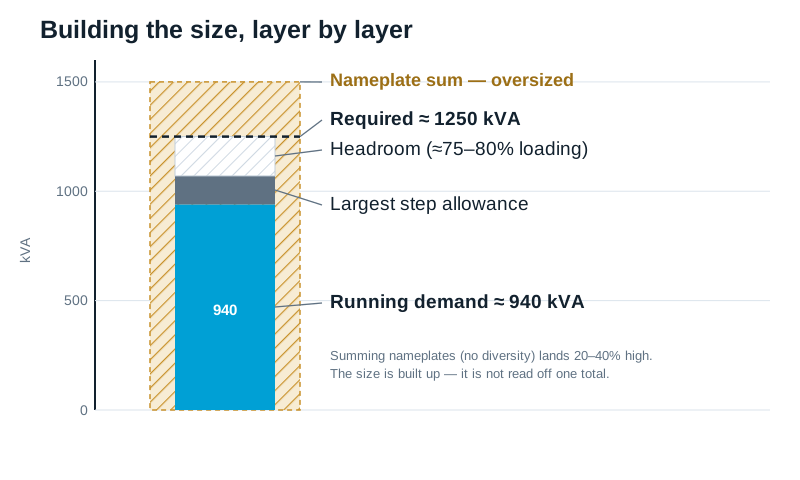
For our building, the backed loads come to a running demand of about 800 kW at a site power factor of about 0.85. So the running kVA is 800 ÷ 0.85 ≈ 940 kVA.
From here we carry two numbers, not one: running kW (≈800) and running kVA (≈940).
Step 2 — Standby or prime: which rating does this set need?
Before you calculate anything, answer one question: what is this set actually doing? The rating standard is ISO 8528-1, and four ratings matter:
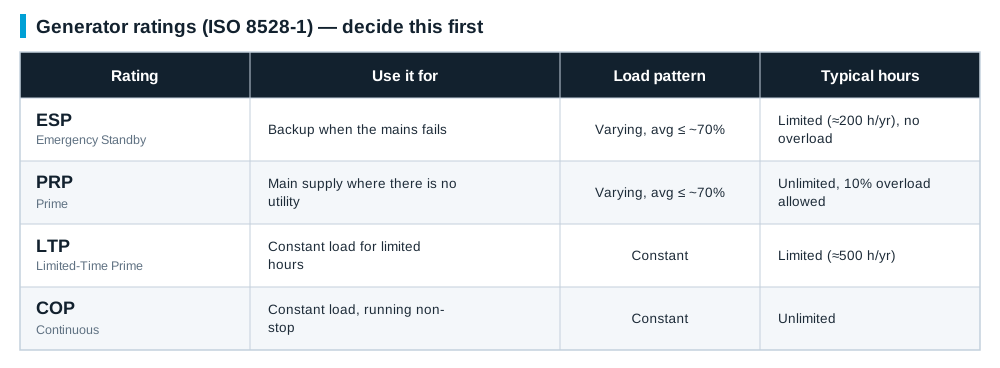
Our building has a utility supply; the set only runs on an outage. That is ESP (standby). Hold onto why it matters: the same physical set gives you a higher standby rating than prime rating, so the wrong choice throws your number off before you have added up a single load. The calculation cannot make this call for you — you decide the duty, and the rating follows.
Engineering observation — the wrong rating is one of the most expensive mistakes we come across, precisely because it is baked in before anyone touches the load schedule.
Step 3 — Can you just add every connected load together?
Before you build the schedule, ask yourself: how much of this building actually runs at once?
Not all of it — and adding every connected load together is one of the most common ways we see a set over-sized. Real buildings never run every load at full power at the same moment.
So build a proper load schedule: list every backed load at its running kW, apply a sensible diversity / demand factor to each group, and total the running demand — not the connected sum.
Let us return to our building:
| Load group | Running demand (kW) |
|---|---|
| Lighting & small power | 200 |
| HVAC — chillers, pumps, AHUs | 470 |
| Lifts | 45 |
| Firefighting auxiliaries (jockey etc.) | 15 |
| Server room / UPS input | 40 |
| Kitchen & miscellaneous | 30 |
| Running demand total | ≈ 800 kW |
What we see on site — in our experience, load schedules built by summing nameplates land 20–40% high. That single habit is behind most of the over-sized sets we are asked to look at.
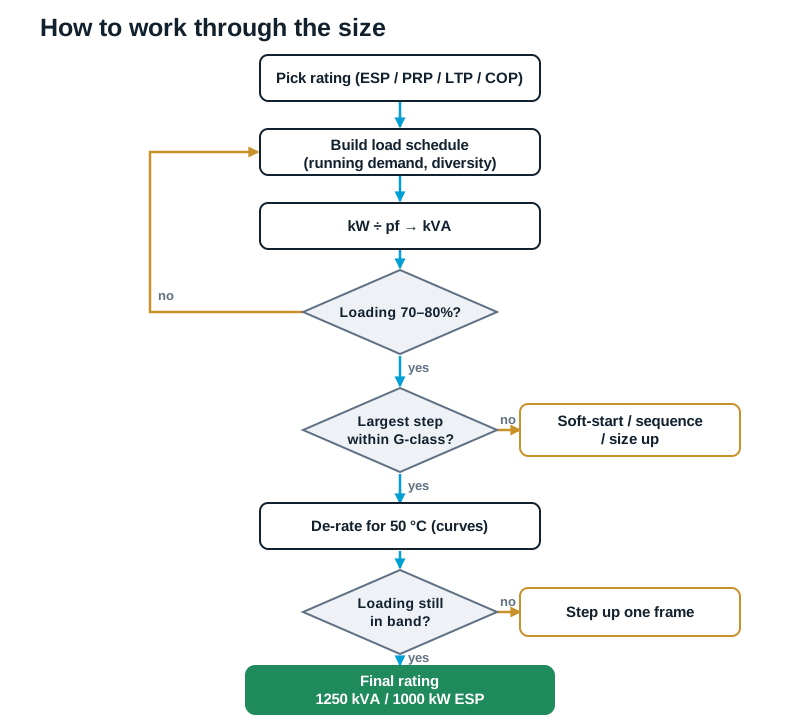
Running demand ≈ 800 kW → ≈ 940 kVA. Aim to run the set at about 70–80% of its rating — not strained, not lightly loaded.
Step 4 — Will it survive the moment the biggest motor starts?
Here is the question that quietly catches people: your set carries the running load all day — but what happens in the half-second the fire pump starts?
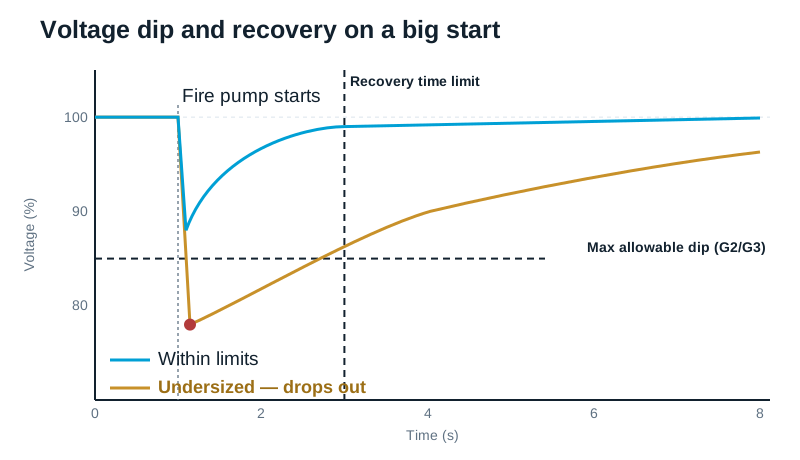
Start a motor direct-on-line and it pulls several times its running current for a second or two. The set's voltage and frequency dip, then recover. If the dip goes too deep, other equipment drops out — and on a sensitive load, that is a real failure, not a flicker.
ISO 8528-5 puts numbers on how far things may dip and how fast they must recover, in performance classes:
- G2 — most commercial buildings (lighting, pumps, fans, lifts).
- G3 — sensitive loads (IT, telecom, medical).
- G4 — the most demanding loads, by special agreement.
Back to our building: the biggest step is the fire pump — a direct-on-line motor whose starting demand is several times its running figure. That single start, landing while other loads are already running, is what decides whether our candidate size holds up. If the dip is too deep for the server room, we either let its UPS ride through it or start the fire pump differently — inside what the fire code allows (Step 6).
Common review finding — the running load was fine; nobody had checked the set against the largest step. That is the gap that turns a "correct" calculation into a nuisance trip.
The fire-pump start, not the running total, is our sizing step. We size so the set takes it within G2/G3 limits.
Step 5 — How much smaller does 50 °C make your generator?
Quick one: is the generator you sized on paper the same size once it is in a 50 °C plant room?
No — it is smaller than the nameplate, and less shrunken than the internet claims.
A nameplate is stated at reference conditions (ISO 3046 — moderate temperature, near sea level). A UAE afternoon is not that. Intake air can hit 50 °C, and the plant room is often hotter than outside. Hot, thin air means less oxygen for the engine and hotter cooling for the alternator, so you get less usable output than the nameplate. You de-rate for it.
This is where most guides go wrong. You will read "de-rate 3% per 10 °C" and "de-rate 30% at 50 °C" — flat rules that contradict each other. Do not size on a rule of thumb. Instead:
- Take the design ambient — for the UAE, the peak (around 50 °C), not the daily average.
- Read the engine de-rating off its own curve, for that temperature and the site altitude.
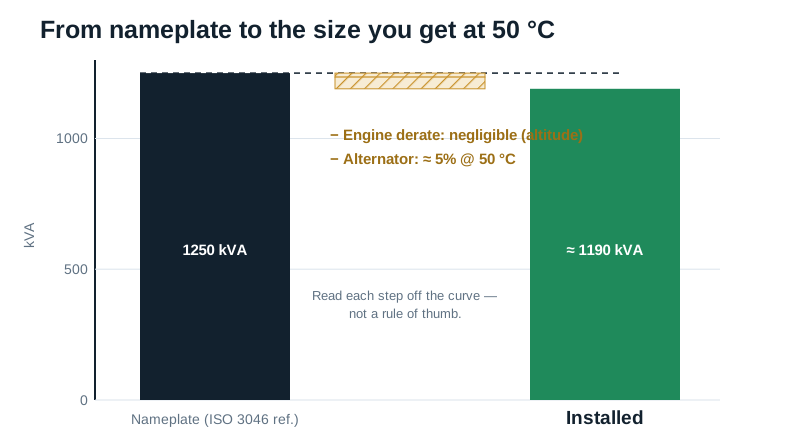
- Read the alternator de-rating separately — many are rated at 40 °C, so 50 °C costs output; a set specified for 50 °C may cost little or nothing.
- Apply the worse of the two, from the real curves for the real machine.
Take a candidate 1250 kVA / 1000 kW standby set. Say its alternator is rated at 40 °C and its table gives about 5% at 50 °C, with altitude low enough to ignore. Installed rating ≈ 1250 × 0.95 ≈ 1190 kVA. Re-check the loading: 940 ÷ 1190 ≈ 79% — still in the healthy band. If the de-rate had pushed loading too high, we step up a frame size, not shrug.
What we see on site — rooms designed around a 40 °C assumption that push intake air past 50 °C in summer, and quietly de-rate a perfectly good set below its paper number. The curve gives you the figure; choosing which ambient to design for is judgement — and no calculator makes that choice for you.
Step 6 — Which loads change the size beyond their kW?
Some loads cost more than their kW suggests. Read only the ones your building has.
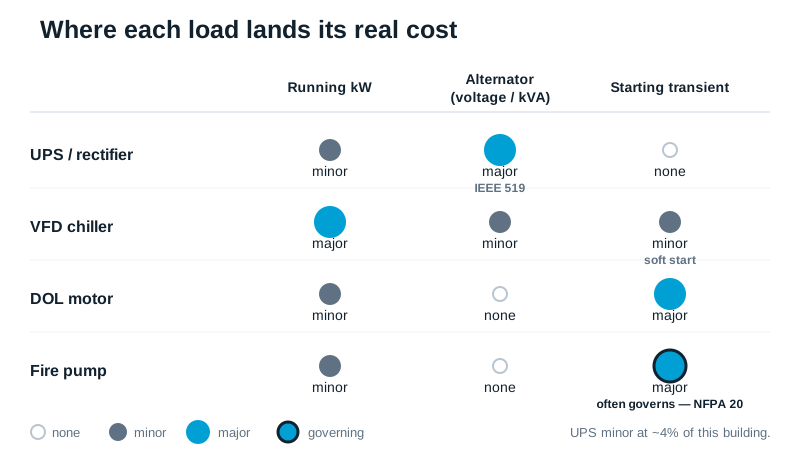
UPS and rectifier (non-linear) loads. A UPS pulls current in pulses, not a smooth sine wave. That distorts the alternator voltage and heats its windings. A small share (our server room is about 4% of the total) is minor. A large share — a data-heavy building — means you oversize or upgrade the alternator to hold voltage under the distortion. IEEE 519 is the reference for the harmonic limits.
Motors and VFDs. Direct-on-line is a big step (Step 4). The same motor on a soft-starter or VFD starts gently, so the step shrinks. Our chillers are on VFDs — easy on the set. The fire pump is not.
Fire pump (NFPA 20). This one has its own rules. The set must start and run the fire pump at its locked-rotor demand while already carrying the other loads, and you cannot freely soft-start your way around it — the pump has to start reliably in a fire. We regularly see the fire-pump start turn out to be the number that fixes the transient size. Treat it as a dedicated check, not as one more motor.
Large step loads. Big chillers or motors on direct-on-line are steps in their own right. If they must start together, sequence them or size for the combined step.
Here, the fire-pump start governs the transient size; the small UPS needs no alternator upgrade; the VFD chillers are gentle. A data centre or an industrial plant would decide differently — see the paths below.
Step 7 — So what do we actually install?
Let us bring our building home. Put the decisions together:
- Rating: ESP (standby).
- Running demand: ≈ 800 kW / ≈ 940 kVA.
- Loading target: about 75–80% of rating.
- Candidate: 1250 kVA / 1000 kW.
- Transient: takes the fire-pump start within G2/G3, with the UPS riding through the dip.
- De-rated at 50 °C: ≈ 1190 kVA installed; running load ≈ 79% — healthy.
Final selection: a 1250 kVA / 1000 kW ESP set, alternator suitable for 50 °C, performance class to suit the server room. Every part of that is defensible — the rating, the load schedule, the step, the de-rate.
And notice what did not happen: we never picked 1250 "to be safe." We arrived there because the running load, the loading band, the fire-pump step and the 50 °C de-rate all pointed to it. Calculators produce numbers; engineers decide whether the number belongs in this plant room. The standards and the sums carried us here — they did not make the call. We did, at each step. Change any input and the number moves with it.
Which path is your project?
Our worked example is one path — a commercial building. Other buildings weight the same steps differently. Find yours:
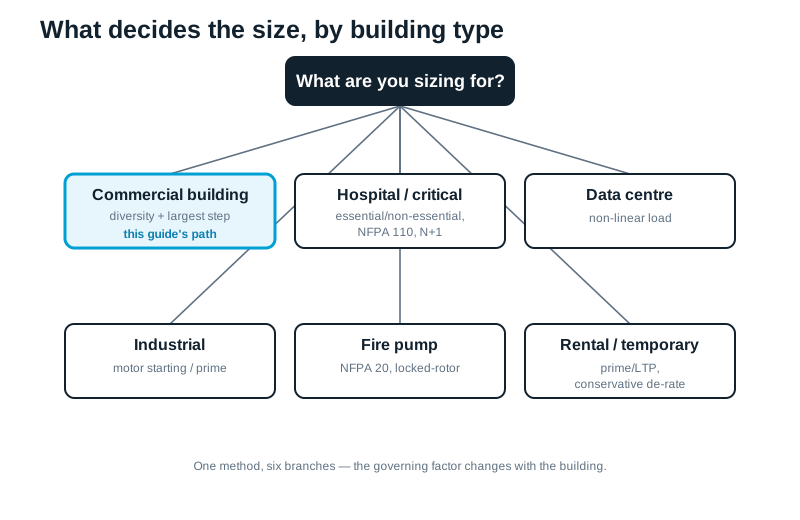
Each has its own guide. This one takes the commercial-building path to a finished number; step across when your project sits in another row.
Where does generator sizing usually go wrong?
A quick self-check against the ones we see most:
- Sizing on running load only — the set carries the load, then collapses on the largest step. Fix: size the step (Step 4).
- kW / kVA / pf confusion — a number that suits the engine but not the alternator, or the reverse. Fix: carry both (Step 1).
- Wrong rating — standby figures used for a prime duty. Fix: pick the rating first (Step 2).
- Nameplate-sum load schedules — no diversity, 20–40% over-sized. Fix: demand, not connected (Step 3).
- Flat-percentage de-rating — a rule of thumb instead of the curve. Fix: read the engine and alternator curves at 50 °C (Step 5).
- "Bigger to be safe" — the over-sized set runs lightly loaded, wet-stacks, and wears out. The paradox we opened with.
You have the number — what comes next?
Once the size is fixed, the next decisions are the enclosure (open, silent, or containerised), the generator room and its ventilation, the fuel system and its Civil Defence requirements, and the earthing and protection. Those are separate decisions with their own guides in this series — sizing comes first, because everything downstream hangs off the number you just set.
Which standards sit behind these decisions?
ISO 8528-1 (ratings), ISO 8528-5 (transient performance classes), ISO 3046 (engine reference conditions and de-rating), IEC 60034-1 (alternator rating and temperature), IEEE 519 (harmonics / non-linear loads), NFPA 110 (emergency and standby systems), NFPA 20 (fire-pump drivers). UAE authority requirements (DEWA, SEWA, Etihad Water & Electricity, ADDC, and Civil Defence) apply to the connection, earthing and fuel/room, and are covered in the installation guides. Each one sets a limit or a method — none of them makes the decision for you. That is still the engineer's job.
Want a second set of eyes on your number?
One last thing worth saying plainly. Change a single assumption — the diversity you allowed, the design ambient you picked, which motor is really the largest step — and the final size moves. The number is where sizing ends, not where it begins, and the maths is only ever as good as those inputs. That is exactly why a second look is worth having.
So if you want your sizing checked, send us three things:
- the load schedule,
- the single-line diagram, and
- the motor list.
We will size it independently and tell you what we get, and why. It is the same method you have just read — and the review stands on its own, whether or not you buy the set from us. Arab Tower works on generator sizing across the UAE and internationally, from the sizing study through supply, installation, testing and commissioning.
Talk to our engineers → · or see our diesel generators.
Go deeper: Generator Ratings Explained · Step Loading & Transient Performance · UAE Derating in Practice · Enclosures: Open vs Silent vs Containerised · Generator Installation Design.