Generator Commissioning: What the Test Must Establish Before You Sign
A generator starting and transferring does not by itself complete commissioning. Learn what each test establishes, what it leaves open, and what evidence you need before signing.

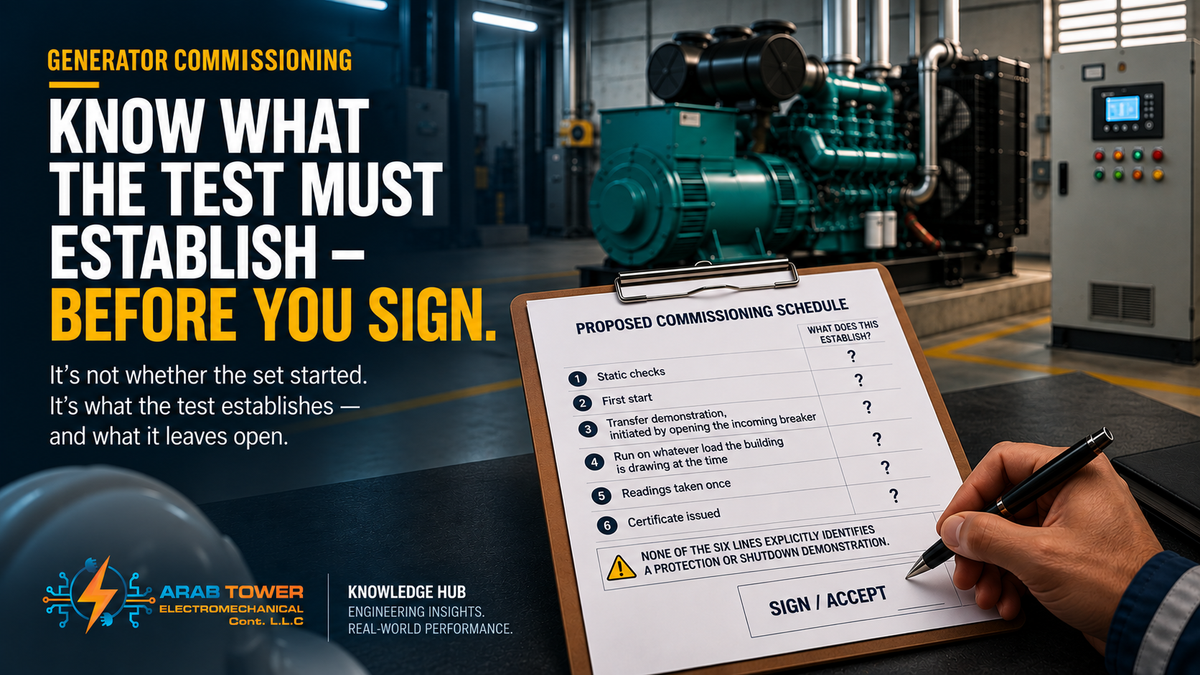
Generator commissioning is not complete because the set started, the transfer worked and a sheet was signed. Before you accept the installation, the test has to establish the specific performance and functions your project requires — and the records have to show what was tested, under what conditions, and what was left untested.
That is what you are signing for. Two commissioning schedules can both end in "PASS" and establish very different things.
This guide is about judging a proposed generator commissioning before you sign it: which requirements govern the project, what each demonstration actually establishes, what it does not establish, and what evidence has to survive in the handover file.
Not covered here. Load-bank testing as a method — what it reveals and how it is interpreted — is its own subject. So are paralleling and synchronising commissioning, why a correctly designed installation still fails on site, diagnosing a set that will not start, and sizing. Each is linked where it belongs. Routine maintenance and service intervals are a different discipline, and are not part of acceptance.
1 · The schedule you are being asked to accept
Take a realistic case, used throughout this guide. A G+8 mixed-use building in the UAE. One standby set backing life-safety systems, essential lifts and part of the landlord's essential distribution. Practical completion is close and everyone is in a hurry.
The supplier issues a proposed commissioning schedule for a single morning. Six lines:
- static checks;
- first start;
- a transfer demonstration, initiated by opening the incoming breaker;
- a run on whatever load the building is drawing at the time;
- readings taken once;
- certificate issued.
Every one of those is a genuine activity, and nothing in the schedule is dishonest. But the engineering question is not whether each activity happened. It is what each one establishes — and what it leaves open.
Keep those six lines in mind. The rest of this guide works through them.
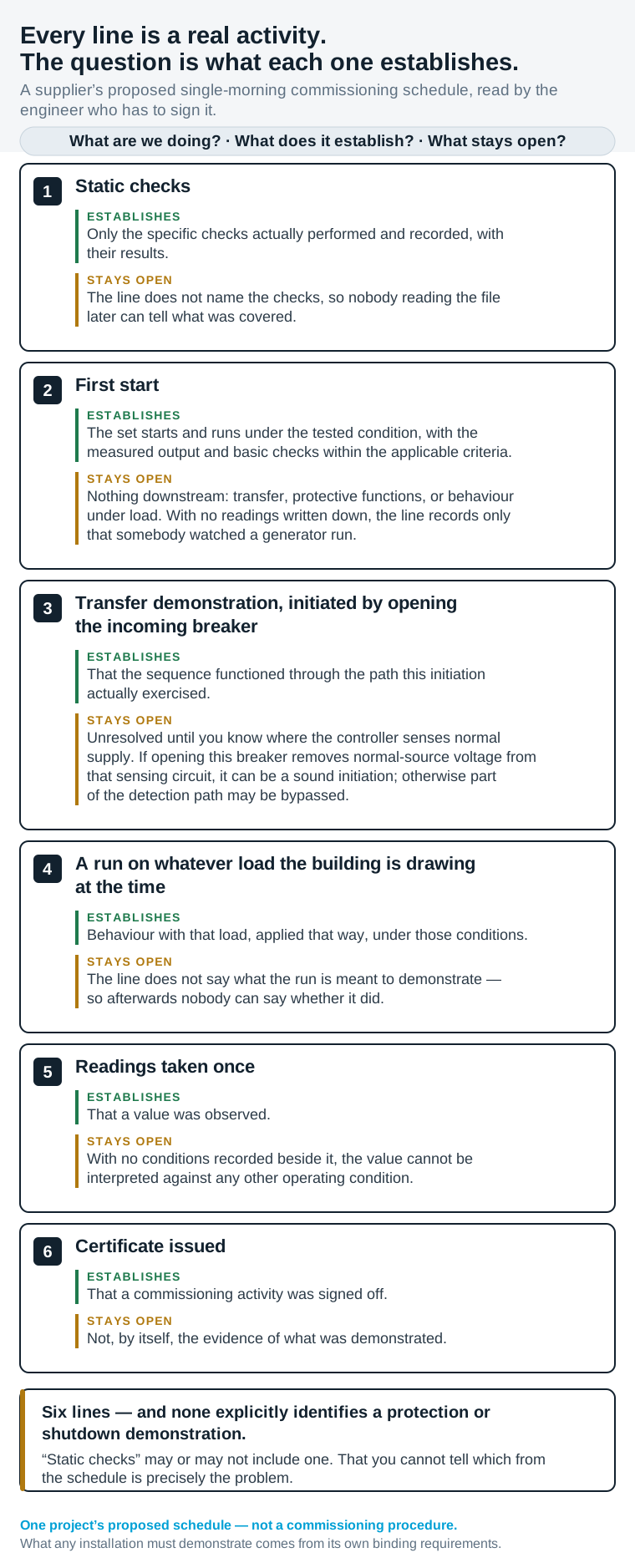
A certificate is evidence that somebody signed off a commissioning activity. It is not, by itself, the evidence of what was demonstrated — and it is that second body of evidence you are being asked to stand behind.
2 · Before the witness date
2.1 · Is the test ready to happen?
Before the date is fixed, confirm two things. That the installation is in its final testable condition — complete in the areas being tested, handed over by the supplier for testing, with fuel and cooling systems in their permanent arrangement rather than a temporary one, and the electrical installation verification done rather than assumed. And that the ITP is approved, not merely circulated: it is the document that says what will be demonstrated, who witnesses it, and what counts as a pass.
A test that cannot proceed wastes the day and creates pressure to accept a reduced version of itself.
2.2 · Which requirements bind this project?
There is no universal rulebook for generator commissioning. What binds your project is a specific set of documents, and they do not always agree. Typically in play:
- applicable legislation, regulation and authority requirements — including the requirements of the authority and distribution company for your emirate, and Civil Defence where the emergency function, fuel system or generator room are engaged;
- the contract's own order-of-precedence clause;
- the project specification;
- the approved drawings and submittals;
- the manufacturer's requirements and operating limitations;
- any standards the project invokes.
Find the order of precedence rather than inventing one. It is written down somewhere for your project, and it is usually not what people assume. Read it before the witness date, not during an argument on site.
Where requirements conflict, resolve the conflict — do not quietly pick the convenient document. A conflict discovered on the witness morning is already a problem; the same conflict raised when submittals were being agreed is just a question.
One case recurs and is worth naming. An approved ITP does not carry the authority to override a manufacturer's operating limitation. If the test method in the ITP would require the set to be operated outside what the manufacturer permits, that is not permission — it is a conflict somebody must resolve in writing, before the day.
2.3 · Standards apply by scope, and by whether your project invokes them
- ISO 8528-5:2025 — design and performance criteria for the generating set. The right reference for judging set performance; not a site commissioning procedure, and it does not tell you what your project must demonstrate.
- NFPA 110 — emergency and standby power systems, including installation acceptance, where the code is adopted or the specification invokes it. Not the universal law of generator commissioning.
- IEC 60364-6 — verification of the electrical installation.
- Abu Dhabi DoE Electricity Wiring Regulations 2020 — within their own regulatory context. UAE authority and distribution-company requirements vary by emirate and by project, so "the regulations" always means your project's regulations.
3 · The sequence, and what each step establishes
Every demonstration gets the same three questions:
What are we doing? · What does it establish? · What does it NOT establish?
The third is the one nobody writes on a test sheet, and it is the one that decides whether you should sign.
3.1 · First start and no-load verification
Starting the set and letting it run unloaded. Measuring the electrical output — voltage, frequency, phase sequence — and carrying out the basic operating checks: pressures and temperatures settling as the manufacturer expects, nothing leaking, loose or overheating.
It establishes that the engine-generator starts and runs under the tested condition, and that the measured output and basic checks were within the applicable acceptance criteria.
It does not establish anything downstream — the transfer arrangement, the protective functions, or the installation under load. Nor does it establish that the installation is correctly connected: what was measured is the set's own output under one condition, and what matters to a transfer arrangement is the relationship between sources, which this step does not exercise.
Back to our schedule. Line 2 says "first start", and nothing more. That is enough to record the above — provided somebody writes down what was measured. A tick with no readings records that the first-start activity was signed or marked complete; it gives the later reader little evidence of what was observed.
3.2 · Protective functions and safety shutdowns
Demonstrating that the protective functions and safety shutdowns operate — by an appropriate, approved test method. That can be an approved simulation, a signal injection, a controller-input test, a test switch, or the manufacturer's own procedure. What matters is that a function was stimulated and its response observed, not that a hazardous condition was manufactured to prove a point. Creating a real low-oil-pressure or overspeed condition is usually neither necessary nor sensible.
What it establishes depends on where the stimulus entered. A protective function is a chain:
physical condition → sensor or transducer → sensing circuit and wiring → controller input → logic → alarm or shutdown output → the device that finally acts
The test can demonstrate only the parts of that chain downstream of the injection point that were actually exercised by it — and it cannot establish anything upstream. That is not a bad test. It is a test with a known boundary, and the boundary belongs in the record.
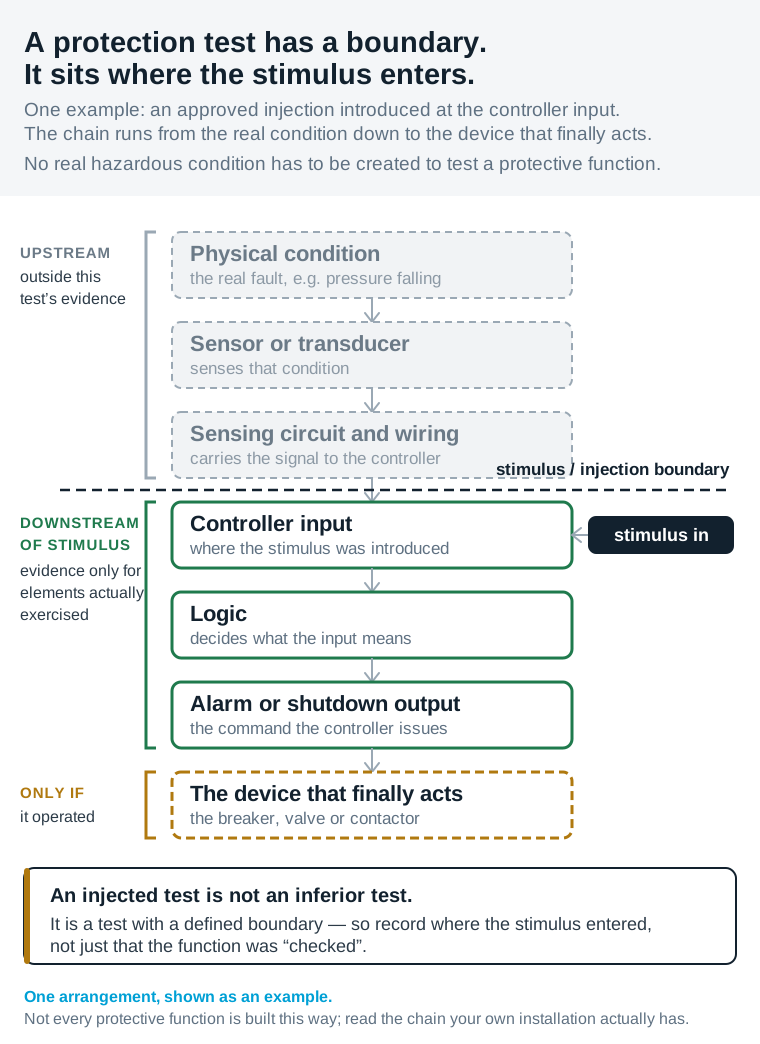
It does not establish anything about functions that were not tested at all — and this is where sheets mislead. A line reading "protections checked" may mean the relay was confirmed present, or that a label was read. Ask three things of every protective function on the sheet: where did the stimulus enter, what responded, and therefore which part of the chain has actually been demonstrated?
Back to our schedule. Six lines, and none of them explicitly identifies a protection or shutdown demonstration. "Static checks" may or may not include one — and that you cannot tell which from the schedule is precisely the problem.
3.3 · The automatic loss-of-normal-power sequence
Demonstrating the sequence the installation will rely on when nobody is watching: loss of normal supply detected, the set started, load transferred, then — when normal supply returns — transfer back and cool-down. Note the word functional: a manual start demonstrates that the set can be started by that command; it does not demonstrate the automatic loss-of-normal-power sequence.
How it is initiated is installation-dependent. In a new, unoccupied building it may be appropriate to remove the normal supply directly. In a live, occupied building that may be unacceptable, and an approved simulation or test arrangement is used instead. Both can be legitimate. What is not legitimate is failing to record which was used.
It establishes that the sequence functioned through the path that was exercised, with the timings recorded. It does not establish any part of the detection and control path that the chosen initiation did not reach — and the question is not which device was operated but where the loss was initiated relative to the point at which the controller senses normal supply.
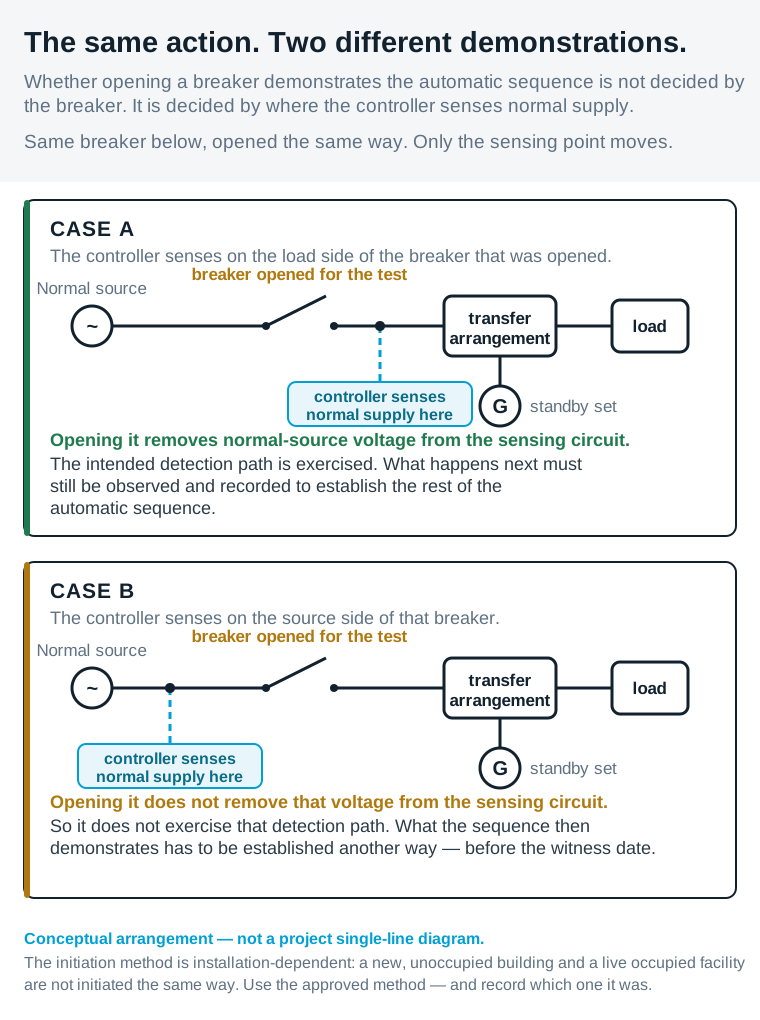
Back to our schedule. Line 3 says "transfer demonstration, initiated by opening the incoming breaker." That may be exactly the right method here. The schedule simply does not say where the controller senses normal supply, so nobody can yet judge what the demonstration will cover. That is a question to ask before the date, not a fault to allege.
3.4 · The load performance and duration your project requires
Applying load, observing how the set and the installation behave, and running for the duration the project requires while watching the quantities that change slowly — temperatures, pressures, and whether readings settle or keep climbing.
Which demonstrations apply, what counts as acceptable for each, and how long the run must be all come from your project's binding requirements, not from a standard list somebody carries between jobs. Where a specification requires particular behaviour when load is applied in steps, that behaviour must be demonstrated. Where it does not, manufacturing the requirement on the day helps nobody.
It establishes that the installation behaved as observed — with that load, applied that way, for that duration, under those conditions.
It does not establish performance under a load it was never given, applied in a way it was never applied, or beyond the duration run. A short run tells you the set started and kept going; it does not tell you where temperatures would have settled, which is what the room's cooling-air path and ventilation design exist to control.
Back to our schedule. Line 4 is "a run on whatever load the building is drawing at the time" — during fit-out, whatever that happens to be — and no duration is stated at all. Nowhere does the schedule say what the run is intended to demonstrate, which means afterwards nobody can say whether it did. Fixing that costs nothing before the date.
3.5 · The readings that turn a test into evidence
Recording what was measured, when, by what instrument, and — most often missed — under what conditions: ambient, time of day, the state of the building, the load actually present.
Back to our schedule. Line 5 says "readings taken once". Once may be enough, depending on what the project requires. Once with no conditions recorded is a value nobody can use later — for the reason §5 sets out.
4 · The loading question, asked properly
The question is not "was it tested at full load?" That has no general answer, and asking it invites the wrong argument. The better question is:
What load performance must this installation demonstrate, against what acceptance basis, and by what means?
The acceptance basis comes from the binding requirements in §2.2. The means — building load, a load bank, or a combination — is a separate engineering decision with its own limitations and interpretation, and is taken up separately.
Settle the first half before the witness date: what must be demonstrated, and on what basis will we agree it was? Two engineers who have agreed that in writing rarely argue on site.
5 · Conditions, and what a result carries
A result is evidence of performance under the conditions it was recorded in. That is not a weakness in the test; it is what a measurement is. So a test carried out on a mild morning is valid evidence — of something narrower than a test at the design condition. Treat it in three moves:
- Record the conditions — ambient, time, load, the state of the building.
- Interpret the result within them — say what was demonstrated, and under what circumstances.
- Identify what further engineering evidence supports performance at the design condition — the manufacturer's derating data, the specified capability of the set, the ventilation design and cooling-air path, the room temperature rise the design assumed, and the sizing basis.
Both errors matter equally. A file that reads as though the design condition was demonstrated when it was not leaves whoever inherits the installation unable to tell what was ever established; and a test outside peak conditions does not make an installation unproven — it makes it proven for what it demonstrated, with the rest carried by engineering evidence. Say which is which.
6 · The record set
A useful commissioning record lets another engineer determine what was demonstrated, how, under what conditions, what deviations remained, and what state the installation was left in. In practice that means the demonstrations performed and the method used for each — including the point at which a test stimulus was introduced, where that matters; the results with their conditions and instruments beside them; the settings and state the set was returned to; the deviations from the plan and what was agreed about them; and the outstanding items with owners against them.
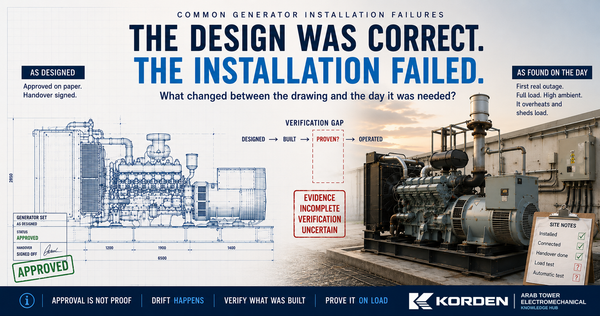
That last one is not administrative. A set left in the wrong state after commissioning — controller in manual, a switch not returned, an isolator open — is where a correctly designed installation quietly becomes a non-functioning one, and it is covered in our guide on common generator installation failures.
If you have inherited a thin file, the three questions work backwards: take each entry and ask what it establishes and what it leaves open. Usually a surprising amount was demonstrated, the conditions were never recorded, and two or three specific things were never tested at all. That is a scope of work, and a cheaper one than assuming everything must be redone.
7 · What deserves extra scrutiny on your project
Building type does not create acceptance requirements — your binding documents do, and §2.2 is where they come from. What building type tells you is where to look hardest, and which requirement to go and find before somebody hands you a schedule.
A · Commercial building, no emergency-power code adopted, thin specification
WHY IT CHANGES THE READING
The specification and the manufacturer's documents carry most of the weight, and thin specifications leave the load question undefined
WHAT TO GO AND LOOK FOR
Whether the specification says what load performance must be demonstrated and on what basis; whether the initiation method is specified at all; whether anything requires conditions to be recorded
B · Life-safety systems depend on the set (Civil Defence and fire systems engaged)
WHY IT CHANGES THE READING
The emergency function is part of what is being certified
WHAT TO GO AND LOOK FOR
What the authority and adopted code require for that function; what the approved design assumed; whether the fuel system's approval status is closed
C · Critical facility with an emergency-power requirement adopted by code or contract
WHY IT CHANGES THE READING
A specific document governs, and may prescribe more than the parties would otherwise agree
WHAT TO GO AND LOOK FOR
Read that document in its own text; check what it requires for acceptance, and whether the proposed means of loading can demonstrate it — building load may be entirely adequate, or may not reach what is required
D · Existing occupied building — re-commissioning, or an inherited thin file
WHY IT CHANGES THE READING
Occupancy constrains how the sequence may be initiated, and the existing file may be doing work it cannot support
WHAT TO GO AND LOOK FOR
What the existing records establish and what they leave open; what initiation method can be approved given occupancy; what must be re-demonstrated rather than assumed
Different buildings, one habit: decide what must be demonstrated before somebody hands you a schedule that decides it for you.
8 · Before you sign
Three questions, in this order:
- What is this installation required to demonstrate, and which document says so?
- Does the proposed schedule demonstrate it — and what will it leave open?
- Will the record still be interpretable when everyone who was in the room has moved on?
If the evidence is sufficient, sign it — a schedule that is adequate deserves a signature. If it is not, identify the gap before the witness date. Sometimes the correction is small: one added demonstration, one changed initiation method, one extra column in the record. Sometimes it exposes a larger engineering issue — control or transfer logic, ventilation, the fuel system, protection settings, or the load capability itself. Either is better discovered before acceptance than after it.
Talk to our engineers
Before your witness date, send us the proposed commissioning schedule and your commissioning specification. We will tell you what it establishes, and what it leaves untested.
Arab Tower Electromechanical Contracting has supplied, installed and commissioned electromechanical installations across the UAE and internationally since 2003, with an in-house testing and commissioning team — power quality, thermography, earth, insulation and short-circuit testing, primary and secondary injection, transformer oil testing and relay testing. If your schedule is adequate, we will tell you that too.
Go deeper: testing & commissioning · common generator installation failures
Engineering references
- ISO 8528-5:2025 — Reciprocating internal combustion engine driven alternating current generating sets — Part 5: Generating sets. Design and performance criteria for the generating set.
- NFPA 110 — Standard for Emergency and Standby Power Systems, where adopted by code or invoked by the project specification.
- IEC 60364-6 — Low-voltage electrical installations — Part 6: Verification.
- Abu Dhabi DoE Electricity Wiring Regulations 2020, where applicable — noting that authority and distribution-company requirements differ by emirate and by project.
- UAE Fire and Life Safety Code / Civil Defence requirements, where the emergency function, generator room or fuel system are engaged.
- The manufacturer's commissioning requirements and operating limitations for the specific set.