ATS vs Synchronization Panel: Which One Does Your Building Actually Need?

"We need a price — should it be an ATS or a synchronization panel?"
That is one of the most common enquiries we get, and, put that way, it is the wrong question. It treats the answer as a purchase — two products on a shelf, pick the right one. But an ATS and a synchronization panel are not two grades of the same thing, and no building needs either of them in the abstract. What a building has is a requirement: a specific thing that must happen to its supply when the mains fails, or when one generator can no longer carry the load. The panel is the consequence of that requirement, never the place to start.
The equipment is not the decision. The operational requirement is — and once it is stated plainly, it chooses the equipment for you.
Start at the hardware and the scheme can drift either way — controls and protection the building will never use, or a switch that cannot do what the site turns out to need. Both mistakes stay hidden until the scheme is being built, which is a costly place to find them. Start at the requirement instead, and there is nothing left to argue about: it has already made the choice.
So this guide works in that order. It sets the two panels aside and asks what the supply actually has to do — how many sources feed the load, whether it may go dead for a fraction of a second during a changeover, and whether two sources are ever allowed to be live together at the same instant. Answer those three, and "ATS or synchronization panel?" stops being a question you need to ask.
What this guide settles — and what it leaves to other guides
It settles enough to choose the right scheme: what an ATS does · what a synchronization / paralleling panel does · the three different jobs people call "synchronization" · open versus closed transition · the three questions that decide the topology · the UAE authority reality · a worked example to a chosen scheme · a decision tree for other projects.
It deliberately does not cover (kept short and linked): the physics of how synchronising works — voltage, frequency, phase angle, the synchroscope — in Generator Synchronization Explained; how to size the sets, in Generator Sizing; and neutral earthing, 4-pole switching and reverse-power / loss-of-mains protection in depth, in Generator Earthing & Protection.
When someone says "we need synchronization," what are they asking for?
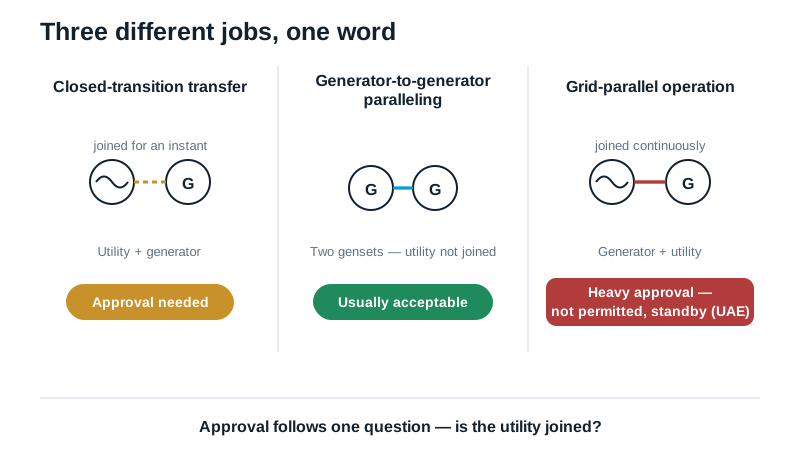
The word covers three different jobs. They do not cost the same, carry the same risk, or need the same authority approval:
- A no-break transfer — no interruption when the building moves between utility and generator. This is closed-transition transfer: a brief, controlled overlap, then one source drops.
- More than one generator sharing the load — two or more sets running together for capacity or redundancy. This is generator-to-generator paralleling.
- Running the generator alongside the utility — the set feeding the building while still connected to the mains, to shave a peak or export. This is grid-parallel operation.
An ATS does none of the three. Its job is to pick one source and connect it, one at a time. The moment you need any of the three, you are specifying synchronising and paralleling control, not a transfer switch.
Keep the three jobs apart and most of the decision becomes straightforward. To keep it concrete, we will follow one building the whole way through.
Our worked example: a mid-rise mixed-use building in the UAE — offices and retail, basement car park, rooftop chillers, a fire pump, and a small server room on a UPS. One utility supply, standby generation required. Ordinary on purpose. As we go, we change one requirement at a time and watch the correct scheme move.
What does an ATS actually do — and why does it suit most standby installations?
An Automatic Transfer Switch has one job: transfer the load between two sources, one at a time.
Utility present, load on utility. Utility fails, the ATS starts the generator, waits for it to be healthy, and switches the load across. Utility returns, it switches back and stops the set. Two sources, one load, one closed path at any instant — never both together, which is exactly why it is simple and reliable.
One decision lives inside the ATS: how it makes the switch.
- Open transition (break-before-make) — disconnects the first source before connecting the second. There is a short dead gap, a fraction of a second, while the load has no supply. This is the most common, simplest and least expensive type.
- Closed transition (make-before-break) — connects the second source while still connected to the first, so the load never loses supply, then opens the first. For that instant the two sources are electrically joined, so they must be in synchronism, and the authority must permit the momentary parallel.
Here is the point most comparison articles skip. For the majority of standby installations, the open-transition ATS is not the budget option — it is the correct engineering answer.
A standby scheme exists to keep the building alive when the mains fails. Almost every load in a normal building — lighting, HVAC, lifts, pumps, general power — rides through a fraction-of-a-second gap without noticing. The genuinely break-sensitive loads are usually already on a UPS, which covers the gap regardless.
So the ATS is asked to do exactly what it does best: select the healthy source, quickly and dependably. Adding synchronising or paralleling to that picture adds controls, protection and failure modes to solve a problem the site does not have.
What we see on site — the most dependable standby schemes we come across are also the simplest: a single set on a well-commissioned open-transition ATS. Fewer components in the transfer path means fewer things to misalign, mis-set or fail on the night the mains actually goes.
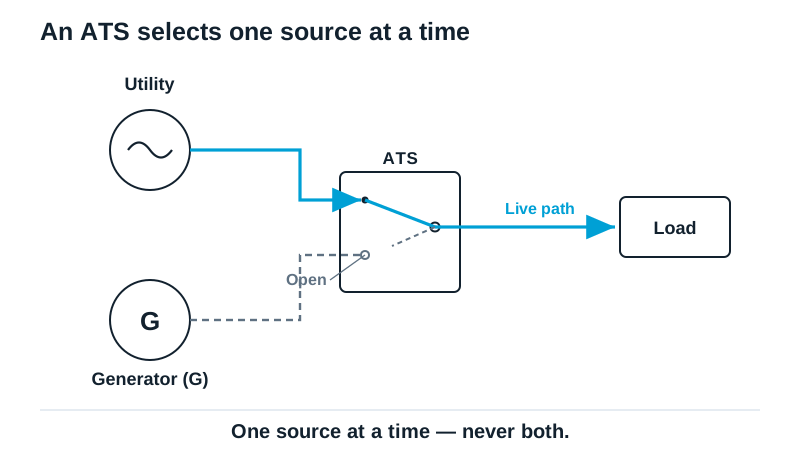
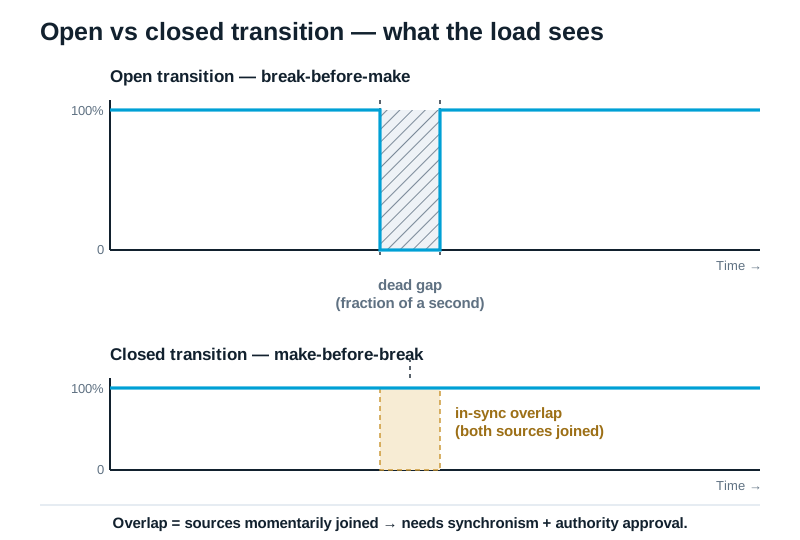
For our building at baseline — one utility, one generator, a momentary break acceptable — an open-transition ATS is the whole answer. Now we change one requirement.
What does a synchronization / paralleling panel actually do?
Where an ATS selects a source, a synchronization panel brings two or more sources into step so they can be connected together — and then keeps them sharing the load without fighting.
To close two live sources onto one bus safely, three things must match at the instant of closing: voltage, frequency and phase angle. Close them out of step and you get a heavy transient — mechanical shock to the sets and a voltage disturbance to the building.
The panel's synchronising control watches those three parameters, closes only inside a narrow window, then manages load sharing so each set carries its fair portion of real power (kW) and reactive power (kVAr). How that works is its own guide — see Generator Synchronization Explained; here we need only know that it is what a paralleling panel is for.
That is a bigger scope than an ATS. It adds synchronising controllers, load-sharing between the sets, and protection an ATS never needed — reverse-power and loss-of-mains (anti-islanding) protection, and check-sync relays on the closing breakers. More panel, more control, more commissioning. It earns that cost only when the site needs one of the three jobs above.
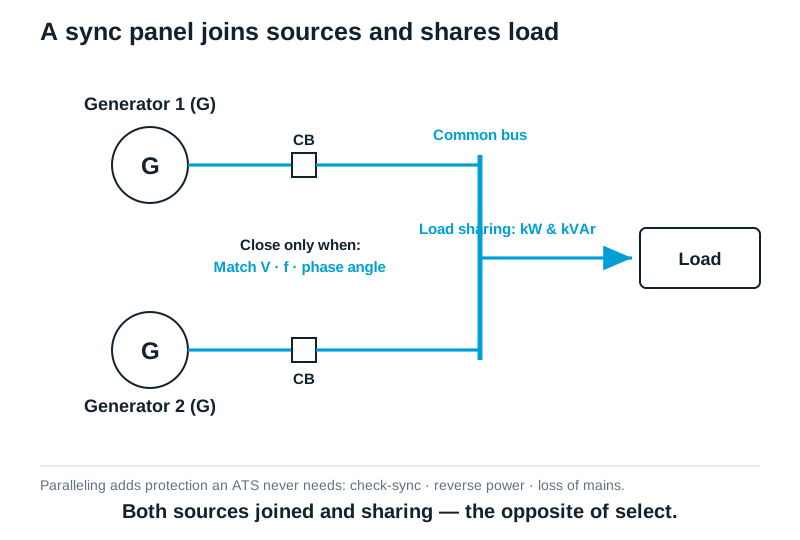
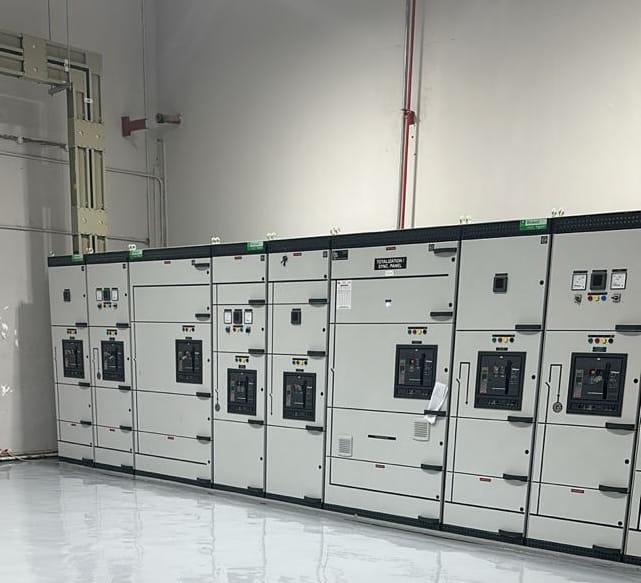
Engineering observation — the most common misconception we come across is that an ATS can "parallel my two generators." It cannot. A transfer switch selects one source at a time; sharing load between two sets needs synchronising and load-sharing control. If two sets must run together, an ATS is not a cheaper alternative to a sync panel — it is a different tool for a different job.
The three jobs people call "synchronization" — kept apart
The whole decision turns on which of these (if any) your building needs. They differ in cost, in protection, and — critically in the UAE — in authority approval.
Authority approval does most of the work in the UAE. Closed-transition and grid-parallel both join the generator to the utility, so both need permission. Generator-to-generator paralleling never touches the utility, so it is the one form of real paralleling that is normally straightforward to approve.
The three questions that decide the topology
Answer these in order, and the scheme falls out.
1 — How many sources feed the load at once? One utility and one generator → choose between an open- and a closed-transition ATS (Question 2). One utility and two or more generators that must run together → a paralleling panel; go to Question 3.
2 — Is a momentary break on transfer acceptable? For most buildings, a fraction-of-a-second gap is fine → open-transition ATS, the UAE default. If even a momentary break is genuinely unacceptable → closed-transition ATS, with the approval its momentary parallel needs.
One honest check first: many "no break" needs are already served by the UPS, which rides through the transfer. If a UPS protects the load, you may not need closed transition at all. (See UPS Systems.)
3 — May the sources ever be joined — and will the authority allow it? Generators joined only to each other, utility never joined → generator-to-generator paralleling (still needs check-sync and reverse-power protection, and commissioning). Generator joined to the utility → grid-parallel, the approval-gated exception, generally not permitted for standby sets in the UAE.
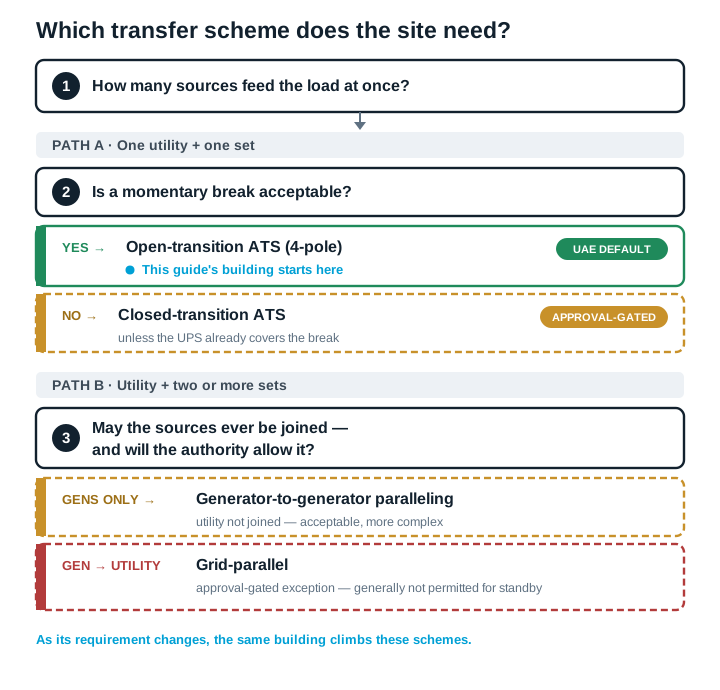
Watch our building move as its requirement grows:
- One utility, one generator, momentary break acceptable → Open-transition ATS (4-pole) — the UAE default.
- A floor now carries a process that cannot see a momentary break → Closed-transition ATS — needs approval (unless the UPS already covers it).
- Load outgrows one economical set; two sets wanted for capacity and N+1 → Generator-to-generator paralleling — sets synchronised, then the group transfers to the load.
- Someone asks to run in parallel with the utility to shave peaks → Grid-parallel — the exception: heavy approval, generally not permitted for standby; usually "no".
The same building lands on three or four schemes purely as the requirement changes. You are not choosing a panel; you are reading a requirement. And in the UAE, one authority rule shapes almost every answer above — so it is worth understanding directly.
What does the UAE authority reality do to this decision?
This is where much of the global "closed transition is better" content stops helping, and where the decision becomes simpler than the textbooks suggest.
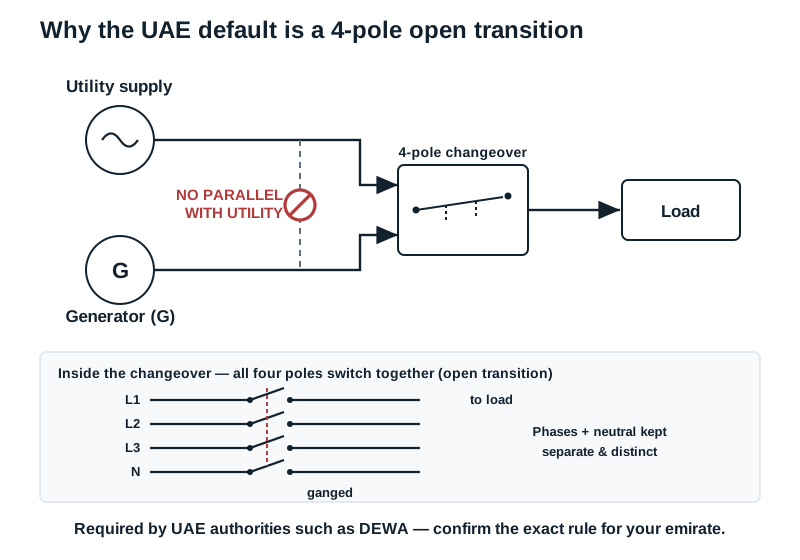
UAE distribution authorities generally require a standby-generator changeover to be a 4-pole, break-before-make arrangement. The generator's phases and neutral stay separate and distinct from the utility's, and the generator can never be paralleled with the utility supply. Standby-generator connection is permitted only with the authority's prior approval.
In plain terms: the default the authority expects is an open-transition ATS. Any scheme that joins the generator to the utility — closed transition or grid-parallel — is the exception that must be applied for and justified.
That fact decides most UAE buildings:
- Open-transition ATS — the normal, expected scheme; no parallel with the utility, and no interconnection approval.
- Generator-to-generator paralleling — acceptable; the sets parallel to each other, and the utility is still transferred open-transition to the paralleled group.
- Closed-transition ATS and grid-parallel — approval-gated exceptions, because they join the generator to the utility. The approval is part of the design.
Common review finding — a closed-transition scheme drawn to give the client a no-break transfer, with no allowance in the programme for the authority approval its momentary parallel needs. It surfaces late, and the scheme is reworked. In the UAE, the transition type is an authority decision as much as an engineering one — settle it before it reaches the drawing.
Which authority applies depends on the emirate — DEWA, SEWA, Etihad Water & Electricity, or ADDC — and the exact wording on 4-pole changeover and closed-transition approval should be confirmed against the current regulation for your site. The principle is consistent; the detail is worth verifying.
Which scheme is your project?
Our worked example is one path — a commercial building whose honest answer is an open-transition ATS. Other projects weight the three questions differently:
- Commercial building — one set, momentary break acceptable → open-transition ATS. (The worked example.)
- Hospital / critical facility — life-safety supplies that cannot break, essential/non-essential segregation, often more than one set → closed transition and/or paralleling, with the approval that entails.
- Data centre — continuity carried by the UPS; generators usually parallel to each other for capacity and N+1, transferred open-transition to the utility.
- Industrial facility — multiple sets for capacity, process loads, staged starting → generator-to-generator paralleling; grid-parallel only where a genuine, approved case exists.
- A building wanting to run with the grid — peak shaving / export → grid-parallel, the approval-gated exception; confirm the authority position first.
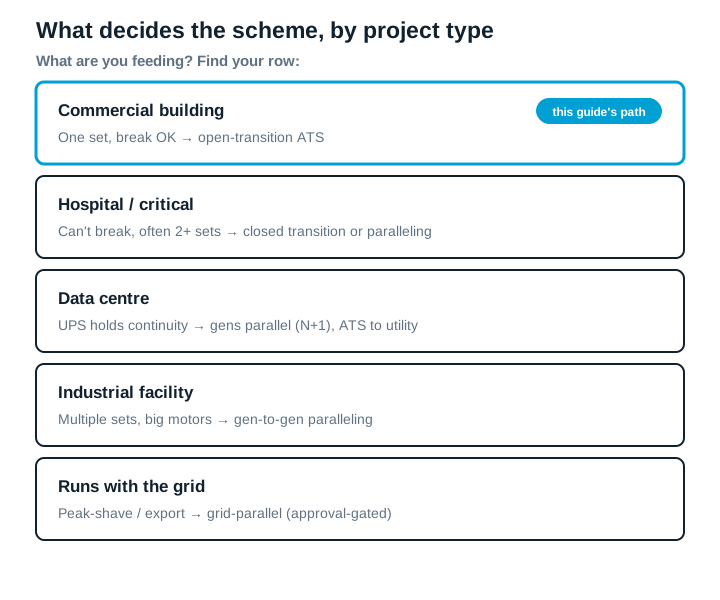
The sizing of the sets is a separate decision — see Generator Sizing. This guide takes the commercial-building path to a chosen scheme; step across when your project sits in another row.
The cost of choosing the wrong topology
Panel price is the smallest number in this decision. The real cost lands when the topology is wrong — and it goes wrong in two directions.
Over-specifying — a paralleling panel where a single-set open-transition ATS was all the site needed. The client pays for synchronising controllers, load-sharing, check-sync and anti-islanding protection, and the commissioning to prove them — for a capability the building never uses. Worse, every added component is another thing to mis-set, maintain and fail in the transfer path the building depends on. Complexity is not free insurance; it is a standing liability.
Under-specifying — a single ATS where the load genuinely needed two sets in parallel. The scheme cannot be built as drawn. It emerges during design review, or on site, and becomes a redesign, a re-approval and a variation against the programme. The cheap panel becomes the expensive mistake.
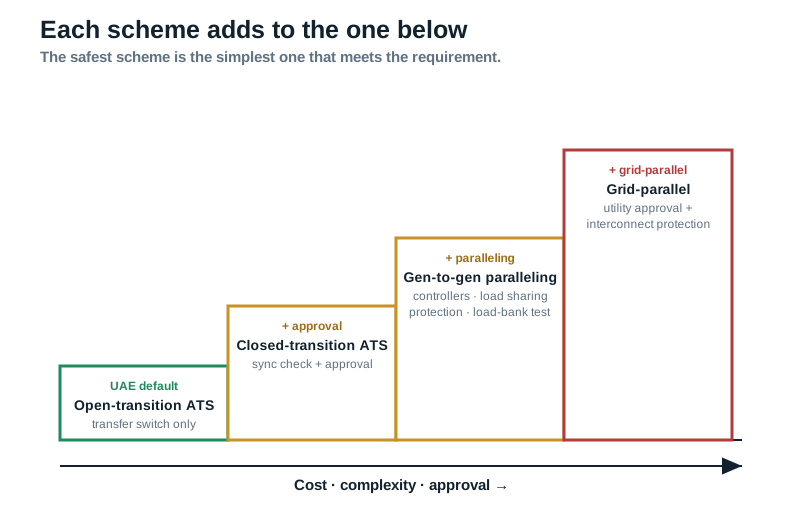
Between those two failures sits the ladder of what each scheme actually adds:
What we see on site — paralleled sets that pass a static check at handover, then share load poorly once real load arrives — one set pulling more than its share of kW or kVAr until the control is properly commissioned. Paralleling only earns its cost if the sets share reliably and can drop out without a damaging transient — proven on a load bank and under real steps. (See Commissioning & Load Testing.)
The decision is not "which panel is better." It is "what is the least scheme that meets the requirement." The best scheme is the simplest one that does the job — usually an open-transition ATS, and a paralleling panel only where a real requirement pays for it.
Planning the future expansion path
A fair question from an owner: what if the load grows later, or we add a second set for redundancy — have we boxed ourselves in with a simple ATS?
The answer is to separate the decision you must make now from the one you can defer — and to leave the door open cheaply.
An open-transition ATS is the right scheme today for a single set. But if there is a credible chance of a second set within the plant's life, a little provisioning now saves a rebuild later: leave physical space and a spare way in the switchboard, size the busbar and the generator breaker for the future arrangement, choose a genset controller that already supports paralleling, and lay out the drawings so a common bus can be added without moving the first set.
None of that turns the scheme into a paralleling panel today. It simply means the future set is an addition, not a reconstruction.
Engineering observation — provisioning for paralleling at first install costs a fraction of retrofitting it. Once the room, the busbar and the controller are fixed around a single set with no future allowance, adding a second set later usually means replacing the switchboard — the expensive way to arrive where a little foresight would have put you cheaply.
The rule is simple: build the scheme the site needs today, but do not close the door on the scheme it may need tomorrow — provided that future is credible, not hypothetical.
Common myths versus reality
The same handful of beliefs send schemes wrong. Check yours against them:
- Myth: "A synchronization panel is just a better ATS." Different job. An ATS selects one source; a sync panel joins sources — you choose the one the requirement needs.
- Myth: "An ATS can parallel my two generators." It cannot. A transfer switch connects one source at a time; two sets sharing load need synchronising and load-sharing control.
- Myth: "Closed transition is always better — no break." Only if the site truly cannot break, and the UPS does not already cover it, and the authority approves the momentary parallel. For most standby buildings, open transition is correct.
- Myth: "Any 'sync' scheme means continuous paralleling." No. A closed-transition sync check overlaps two sources for an instant; continuous paralleling runs them together with load sharing and protection.
- Myth: "We can run the generator with DEWA to save on peaks." Generally not permitted for standby sets in the UAE — grid-parallel is the approval-gated exception, not a default.
- Myth: "Protection is the same for an ATS and a paralleling panel." Paralleling adds reverse-power, loss-of-mains and check-sync protection an ATS never needed. Specify it with the paralleling scope.
- Myth: "A bigger, more capable panel is a safer scheme." More components in the transfer path means more to mis-set and fail. The safest scheme is the simplest one that meets the requirement.
Consultant design checklist
Before the transfer scheme goes on the single-line, confirm:
- Sources counted — how many supplies feed the load at once (one utility + one set, or multiple sets)?
- Break tolerance stated — is a momentary break acceptable, and if not, why — and is the sensitive load already on a UPS?
- Parallel intent settled — are any sources ever joined (generator-to-generator, or generator-to-utility)?
- Topology chosen and justified — open ATS / closed ATS / paralleling / grid-parallel, with the reason recorded on the drawing.
- UAE authority position confirmed — 4-pole break-before-make default; any parallel-with-utility applied for early, with programme allowance.
- Neutral earthing and pole count — 4-pole switching where the authority requires phases and neutral kept separate.
- Protection scoped to the topology — reverse power, loss of mains and check-sync added wherever paralleling is used.
- Control philosophy written — the transfer / parallel sequence described, not left to the panel builder to infer.
- Future expansion decided — provisioned for a credible second set, or consciously not.
- Commissioning defined — how load sharing and transfer will be proven under load, not merely witnessed static.
Procurement / RFQ checklist
When the scheme goes out for pricing, make sure offers are comparable. The commonest leveling error here is comparing a bare transfer switch against a full paralleling scope:
- State the topology in the enquiry — open / closed transition, or paralleling — so vendors price the same scheme.
- Specify the transfer-switch class — utilisation and withstand to IEC 60947-6-1, not simply "an ATS."
- List the protection required — reverse power, loss of mains and check-sync where paralleling applies; do not leave it to the vendor to include or omit.
- Name the control and interface — genset controller functions, load-sharing method, and any BMS / monitoring signals.
- Require the authority-compliance statement — 4-pole arrangement, and confirmation the scheme meets the local authority's changeover rules.
- Ask for the commissioning scope — load-bank testing and load-sharing proving included, with witnessing.
- Confirm ratings and future provision — busbar, incomer and breaker ratings, and any allowance for a future set.
- Level like-for-like — reject an offer that has quietly dropped protection, commissioning or the authority scope to win on price.
You have chosen the scheme — what comes next?
Once the topology is fixed, the rest follows from it: the control philosophy, the protection scheme, the sizing of the sets, the room and installation, and the commissioning that proves it.
Each has its own guide — Generator Synchronization Explained for the synchronising physics, Generator Sizing for the set size, Generator Earthing & Protection for protection and 4-pole earthing, and Generator Installation Design for the room and fuel. The scheme decision comes first, because everything downstream hangs off which topology you chose.
Which standards and rules sit behind these decisions?
IEC 60947-6-1 defines transfer switching equipment and its classes. ISO 8528-1 sits behind generator ratings and the reasons sets are paralleled — capacity and redundancy. NFPA 110 sets the emergency- and standby-power context and transfer timing.
The synchronising conditions, load sharing, and the reverse-power and loss-of-mains protection that paralleling needs are covered by the relevant IEC and IEEE paralleling guidance — with the physics detailed in the synchronization guide. BS 7671 / IEC 60364 and the neutral-earthing arrangement sit behind the 4-pole switching.
The UAE authority requirements — DEWA, SEWA, Etihad Water & Electricity, ADDC — govern the changeover arrangement and whether any parallel with the utility is permitted at all. Each sets a limit or a method; none makes the scheme decision for you.
Want a second set of eyes on your transfer scheme?
This decision is easy to get wrong in either direction — a paralleling panel where an ATS was enough, or an ATS where the site needed two sets in parallel — and both are expensive to discover late. Change one requirement — whether a load can break, whether a second set is really needed, whether the authority will allow a parallel — and the right scheme moves with it.
The principle worth keeping: an ATS chooses a source; a synchronization panel joins sources — so specify by what the site must do, never by the panel you would rather buy. The simplest scheme that meets the requirement is almost always the right one.
If you want your scheme checked, send us three things:
- the single-line diagram,
- the generator and load schedule, and
- your transfer / control philosophy — or just tell us what the site must not lose on a power change.
We will tell you which scheme the site actually needs — ATS or synchronization panel — and why, including what the authority will and will not allow. It is the same method you have just read, and the review stands on its own, whether or not you buy the equipment from us. Arab Tower works on transfer and paralleling schemes across the UAE and internationally, from the scheme review and control-philosophy design through supply, installation, testing and commissioning.
Go deeper: Generator Synchronization Explained · Generator Sizing · Generator Earthing & Protection.