Power Quality Analysis in the UAE: A Plain-English Guide for Hospitals, Towers
Breakers tripping for no reason, hot transformers, capacitors that keep failing, a bill that's too high — usually one cause: poor power quality. Here's what a power quality analysis finds, in plain English.


Most electrical problems in a building are blamed on the wrong thing. A breaker that trips "for no reason," a transformer that runs hot, capacitors that keep failing, a lift controller that behaves oddly, an electricity bill that is higher than it should be — these are usually not separate faults. They are symptoms of one thing: poor power quality.
A power quality analysis (PQA) is how you find out what your electricity is really doing. This guide explains, in plain language, what power quality is, what a study measures, how we read the results, and why it pays for itself — whether you run a hospital, a commercial or residential tower, or a factory.
What "power quality" actually means
Think of your electricity supply like water in a pipe. What you want is clean water at a steady pressure. What you sometimes get is water that surges and drops, or comes out sputtering, or carries grit that wears the pipes out from the inside.
Electricity is the same. "Good" power is a smooth, steady wave at the right voltage and the right frequency (50 Hz in the UAE). "Poor" power is that wave disturbed in one of a few ways:
- Sags and swells — the voltage dips or jumps for a moment.
- Transients — sharp spikes, often from switching large loads.
- Harmonics — the smooth wave gets distorted into a jagged shape. This is the big one, and we explain it below.
- Poor power factor — your system is drawing a lot of "non-working" current that does no useful job but still loads the cables, transformers and your bill.
Power quality is simply how clean and stable that wave is by the time it reaches your equipment. A PQA measures it.
Why a power quality analysis pays off — sector by sector
The same disturbance costs different sectors in different ways.
Hospitals. Diagnostic and life-support equipment is sensitive and the cost of downtime is measured in patient safety, not just dirhams. Distorted power can degrade the performance of imaging equipment (more on MRI below), stress UPS and isolation transformers, and cause nuisance tripping in exactly the places you never want it. Clean, verified power protects both uptime and clinical accuracy.
Commercial towers. Lifts, chillers, pumps, IT rooms and building-management systems all sit on the same supply. Harmonics overheat cables and transformers, trip breakers, and shorten the life of expensive plant. Poor power factor shows up directly as a penalty on a large monthly bill.
Residential towers. These are quietly some of the worst offenders. Hundreds of apartments full of LED lighting, phone chargers, TVs and IT loads, plus lift drives and booster pumps, produce a specific kind of distortion (third harmonic) that overloads the neutral conductor and overheats the transformer. The landlord pays the penalty and the repair bills, and tenants feel it as flicker and tripping.
Factories. Variable speed drives (VFDs), welders and furnaces are powerful sources of harmonics and reactive power. The result is overheating motors and transformers, capacitors that fail early, unexplained stoppages, and utility penalties. A PQA is often the cheapest production-uptime investment on site.
What a power quality study actually measures
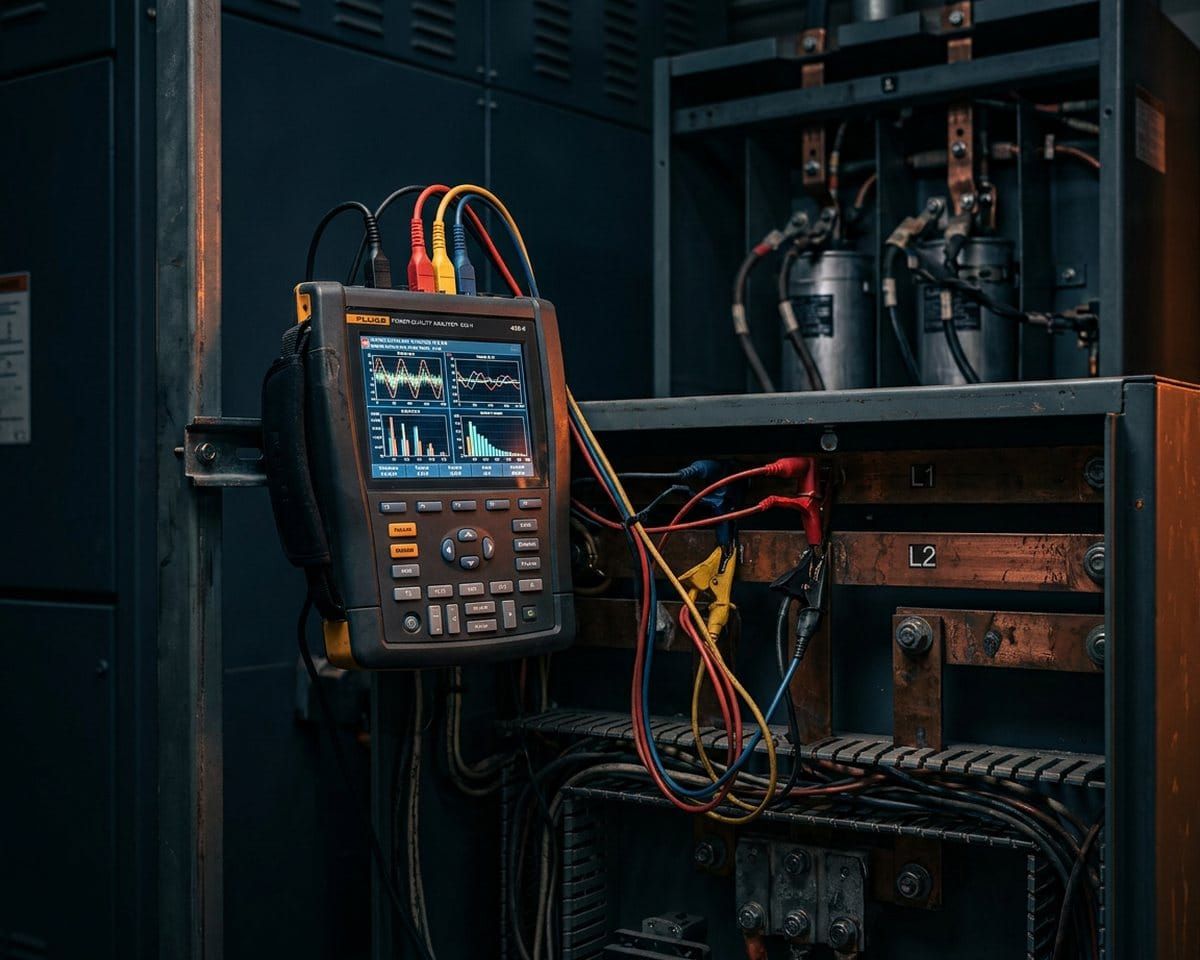
We connect a power quality analyser at the main incomer — and, where needed, at key sub-distribution boards — and let it record continuously. It is a silent, non-intrusive recorder; it does not interrupt your supply.
Over the recording period it logs, for every phase:
- Voltage and current, cycle by cycle.
- Power factor — both displacement (the classic kW/kVA) and true power factor (which includes harmonics).
- Real, reactive and apparent power — kW, kVAR and kVA.
- Total harmonic distortion (THD) on both voltage and current.
- Each individual harmonic order up to the 50th — this is what lets us see which distortion you have, not just how much.
- Sags, swells and transients — captured as events with a time-stamp.
- Voltage and current unbalance between the three phases.
- Neutral current, flicker and frequency.
The output is not a single number. It is a full picture of how your electricity behaves across a real working week.
How long should the study run — and why?
The rule is simple: the study has to run long enough to see a full cycle of how the building actually works. For most facilities that means a minimum of seven continuous days.
A week captures the difference between weekday and weekend, day shift and night shift, peak load and light load, air-conditioning on and off. Snapshot readings of an hour or two miss exactly the events that matter — the moment a large chiller starts, or the evening when every apartment's load stacks up at once. Where a site has strong seasonal swings (a factory with seasonal production, or cooling load that changes with the weather), we extend the period or repeat it.
Should the capacitor bank be ON or OFF during the study?
This is one of the most useful questions in the whole study, and the answer is usually both — we log in both states on purpose.
- Capacitor bank ON shows you the real, present-day condition — including whether your existing bank is making harmonics worse by resonating (explained next).
- Capacitor bank OFF shows the building's "raw" behaviour: the true power factor of the loads themselves and the harmonics they generate before any correction. That raw signature is what we need to design the correct cure.
Comparing the two is often where the real problem reveals itself — for example, a harmonic that is small with the bank off and suddenly spikes when the bank switches in.
How we read the data
Once the week of data is in, the analysis works through three questions.
1. Power factor — are you paying a penalty?
We check your displacement power factor against the utility's minimum (see the UAE rules section). If it sits below the limit, you are almost certainly paying a reactive-power surcharge every month — money that correction pays back quickly.
2. Harmonics — how much, and which kind?
We look at the total distortion and then break it into individual orders. The benchmark for "how much is acceptable" is the international standard IEEE 519:2014, which keeps total voltage distortion at the connection point to roughly 5% (8% on low-voltage systems), with current limits set by how strong your supply is. Being over those limits is the trigger to act.
3. Resonance — is your existing capacitor bank part of the problem?
Here is the plain-English version. A plain capacitor bank and the building's transformer together behave like a tuning fork — they have a natural frequency they "want" to ring at. If that natural frequency happens to land near a harmonic your loads are already producing (very often the 5th or 7th), the bank and the system start swapping energy back and forth and amplify that harmonic instead of helping.
The result: voltage distortion climbs, capacitors run hot and fail early, fuses blow, and correction that was supposed to help is quietly making things worse. In the data we see it clearly — a harmonic that jumps whenever the bank is connected.
Choosing the fix: which detuned reactor?
If the loads produce meaningful harmonics, you should never install a plain capacitor bank — it invites the resonance above. Instead we add a detuned reactor (a small choke) in series with the capacitors. The reactor shifts the bank's natural "ringing" frequency down to a safe value below the lowest strong harmonic, so the bank corrects power factor without amplifying anything.
Which reactor you use depends on which harmonics the study found:
| Reactor rating | Tuned near | Use it when… | Typical setting |
|---|---|---|---|
| 7% | 189 Hz (order ≈ 3.8) | The 5th and 7th dominate — most commercial and industrial sites with VFDs | The general-purpose choice |
| 14% | 134 Hz (order ≈ 2.7) | Significant 3rd harmonic — lots of single-phase, IT and LED load (offices, residential towers) | Protects against low-order distortion |
| 5.67% | 210 Hz (order ≈ 4.2) | The 5th is strong and tighter tuning is wanted | Closer correction where the supply is stiff |
The simple maths. The reactor and capacitor tune to a frequency off = 50 ÷ √p, wherepis the reactor percentage as a decimal. A 7% reactor tunes to50 ÷ √0.07 ≈ 189 Hz— safely below the 5th harmonic (250 Hz). The tuning point must always sit below the lowest harmonic that is present, so the bank absorbs distortion rather than resonating with it.
Which harmonics damage what
Not all harmonics do the same harm. Reading which orders are present tells us what is being stressed and where.
| Harmonic order | Frequency | Where it comes from | What it damages |
|---|---|---|---|
| 3rd | 150 Hz | Single-phase loads — LED drivers, chargers, IT, UPS | Overloads and overheats the neutral; overheats transformers |
| 5th & 7th | 250 / 350 Hz | Six-pulse VFDs, large rectifiers | Motor heating and torque pulsation; capacitor and cable stress |
| 11th & 13th | 550 / 650 Hz | Larger drives and converters | Transformer and cable heating; control interference |
| High orders | above 650 Hz | Fast switching electronics | Interference with sensitive electronics and metering |
Can harmonics make equipment behave abnormally — even an MRI?
Yes — and this is where poor power quality stops being an "electrical" problem and becomes an operational one.
Harmonic distortion doesn't just heat things up. It can distort the voltage waveform enough to confuse the control electronics inside sensitive equipment — causing false triggering, timing errors, and readings that drift. In a hospital, imaging systems are the classic example: published engineering studies have documented harmonic resonance in hospital installations feeding MRI machines, where distortion and the interaction with power-factor capacitors degraded image quality and forced repeat scans. The scanner didn't "break" — the power feeding it was dirty, and the images paid the price.
The lesson applies well beyond MRI: laboratory instruments, precision drives, medical devices and metering can all give unreliable results when the power feeding them is distorted. Cleaning the power protects the accuracy of everything downstream, not just the hardware.
When you need an Active Harmonic Filter (AHF) — and how we size it
A detuned capacitor bank fixes power factor and avoids resonance, but it only partly reduces harmonics. When the study shows harmonics still above the IEEE 519 limits — or when harmonics, not power factor, are the main problem — the right tool is an Active Harmonic Filter (AHF).
An AHF is a fast electronic device that measures the harmonic current in real time and injects an equal and opposite current, cancelling the distortion before it spreads through your system. Published field results show it working hard: documented installations have cut current distortion from around 32% to under 3%, and from 35% to about 3%, bringing sites comfortably inside IEEE 519.
How we size it — the simple steps:
- From the study, read the harmonic current — the part of the current that is pure distortion.
- Add a margin (we normally allow 20–25%) for load growth and to hold THD comfortably under target.
- The AHF must be rated, in amps, for at least that figure.
The simple maths. Harmonic current ≈ load current × THDi. So for an 800 A load measured at 30% current distortion:800 × 0.30 = 240 Aof harmonic current. Add 25% margin:240 × 1.25 = 300 A. You would select a 300 A AHF (the next standard size up). The exact harmonic current can also be read directly from the analyser as√(I_rms² − I_fundamental²).
Which type of AHF? It depends on what you need to fix:
- Harmonics only — if power factor is already fine and you only need to clean distortion, a pure active harmonic filter sized to the harmonic amps (above) is the right, most economical choice.
- Harmonics and power factor — if you also have poor power factor, fast-changing loads, or phase unbalance, choose an active unit that does all three: harmonic cancellation, dynamic reactive (power-factor) compensation and load balancing in one device. This is the better fit for sites where loads change quickly and a switched capacitor bank simply can't keep up.
AHFs also come in two wiring types, and choosing the right one matters:
- Three-wire (three-phase) — for sites dominated by three-phase equipment such as VFDs, large drives and rectifiers (typical of factories and plant rooms). It cancels the harmonics those loads produce — mainly the 5th, 7th, 11th and 13th.
- Four-wire (three-phase plus neutral) — for sites full of single-phase electronics: LED lighting, chargers, IT and UPS loads (typical of commercial and residential towers, offices, data rooms and hospitals). These loads push third-harmonic current that stacks up in the shared neutral and overheats it. A four-wire AHF actively cancels that neutral current as well as the phase harmonics — something a three-wire unit cannot do.
The simple rule: three-phase machinery points to a three-wire unit; lots of single-phase electronics with a loaded neutral points to a four-wire unit. The neutral-current and harmonic-order readings from the study tell us which your site needs.
In practice we often use a combination: a detuned capacitor bank to carry the bulk of the power-factor correction economically, with an AHF trimming the harmonics to target. The study tells us the most cost-effective split.
What the UAE utilities require
Across the UAE, the distribution utilities — DEWA (Dubai), Etihad Water & Electricity (Etihad WE) in the Northern Emirates including Ajman, ADDC/AADC (Abu Dhabi) and SEWA (Sharjah) — all require larger consumers to maintain a minimum power factor at the point of supply, generally around 0.9 lagging (some target 0.95). Fall below it and a reactive-power (kVARh) surcharge is applied to the bill. The exact threshold and rate are set in each utility's electrical-installation regulations, connection agreement and tariff schedule, so the figure on your account should be confirmed against your own agreement.
On harmonics, the utilities and their consultants reference the international standard IEEE 519:2014 as the benchmark for acceptable distortion at the connection point. Large developments increasingly have to demonstrate compliance as a condition of connection.
Why do a power quality study even if no one is forcing you
The utility penalty is the smallest reason to act. Even where nobody is enforcing anything, the long-run savings for a building owner are substantial:
- Stop paying for wasted capacity. Poor power factor and harmonics load your cables and transformers with current that does no work — forcing you to oversize plant and blocking capacity you have already paid for.
- Make equipment last longer. Harmonic heating quietly shortens the life of transformers, motors, cables and capacitors. Clean power slows that ageing down.
- Avoid the failures. Blown capacitor fuses, tripped risers, overheated neutrals and unexplained outages are expensive and always happen at the worst time — in an occupied tower or a running hospital.
- Defer big upgrades. Freeing trapped capacity often lets you add load or delay a transformer or switchboard upgrade.
- Protect accuracy. Sensitive medical, lab and control equipment simply performs better on clean power.
A week-long study is inexpensive insurance against all of the above. The question is rarely "can we afford a PQA" — it is "what is the dirty power already costing us."
How ATEC runs a power quality study
Arab Tower Electromechanical (ATEC) has delivered electrical systems across the UAE and internationally since 2003. Our power quality work follows one accountable line: measure → analyse → report with a properly sized solution → supply and install → verify the result on site. You get a study you can act on, not a data dump — and, where correction is needed, a detuned capacitor bank or active harmonic filter sized from your readings, installed and proven against IEEE 519.
If you suspect a power-factor penalty, keep losing capacitors or fuses, or run sensitive equipment you need to protect, talk to our engineers.
- Learn more: Power Quality Study service · Active Harmonic Filters
- Request a study: Get a quotation or contact our engineers
- Call / WhatsApp: +971 6 743 9371 · WhatsApp +971 58 161 9987
References & standards: IEEE 519:2014, Recommended Practice and Requirements for Harmonic Control in Electric Power Systems; UAE distribution-utility electrical-installation regulations and tariff schedules (DEWA, Etihad WE, ADDC/AADC, SEWA). Harmonic-mitigation performance figures are drawn from published industry case studies and are indicative; actual results depend on site conditions.