How to Size a Diesel Generator for a Building in the UAE

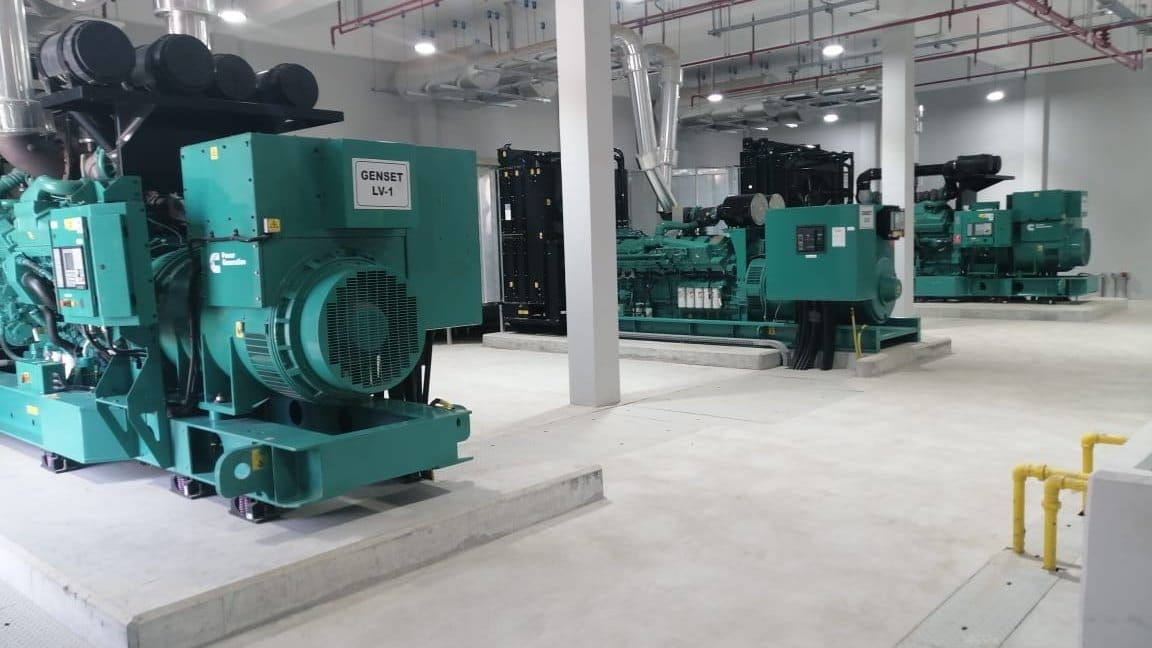
Ask three engineers to size a generator for the same building and you'll often get three different answers. Size it too small and it trips the moment the chillers kick in on a 48°C afternoon. Size it too big and you haven't just overspent — you've bought yourself a maintenance problem (more on that later). The good news is that getting it right isn't guesswork. It comes down to a handful of numbers and knowing what they actually mean. Here's how we go about it.
kW or kVA — which number are you actually buying?
Generators are sold with two power figures, and people mix them up all the time.
kW (kilowatts) is the real, working power — what actually turns your motors, runs your pumps and lights your floors. kVA (kilo-volt-amps) is the apparent power — the total the alternator has to supply, including the part that sloshes back and forth with inductive loads like motors and transformers.
What links them is power factor (PF). Most building loads sit around 0.8 PF lagging, and that's the standard a genset is rated at. The maths is simple:
kVA = kW ÷ PF — and at 0.8 PF, that's just kW × 1.25.
So a 400 kW load needs a 500 kVA generator (400 ÷ 0.8). Flip it around: when a supplier quotes you "500 kVA," they're offering 400 kW of usable power at 0.8 PF. Always check which number you're being sold — it's the most common source of confusion we see.
Standby, prime or continuous — decide the duty first
Before you size anything, you have to decide how the generator will be used, because the same physical machine carries different ratings depending on the job. These come from the ISO 8528 standard:
Standby (ESP) is for emergency backup when the mains fails. It's the highest number on the badge, but it comes with conditions: limited running hours, a variable load that averages no more than about 70% of the rating, and no overload allowance. This is what most UAE buildings actually need — DEWA or Etihad WE power is the primary source, and the genset only steps in when it drops.
Prime (PRP) is for sites with no mains at all — construction, remote facilities, off-grid plant. Unlimited hours, variable load, with a small overload margin. The prime rating is always lower than the standby rating on the same set.
Continuous (COP) is for a constant load, 24/7, with no variation — true base-load work.
Here's the catch that trips people up: one genset might be badged "500 kVA standby / 455 kVA prime." Same engine, same alternator — two numbers, because the duty is different. Size a backup set around the prime figure by mistake and you'll oversize and overspend. Run prime power but design around the standby figure and you'll overload it. So step one is always the same question: what's the duty?
Sizing from your connected load — a worked example
Your connected load is the sum of everything that could draw power. But everything rarely runs at once, so you never size for the full connected figure — you apply a diversity (demand) factor to get the realistic maximum demand. Let's walk a typical commercial building:
- Add up the connected load. Say it comes to 600 kW.
- Apply diversity. Lifts, pumps, AC and lighting don't all peak together. With a demand factor of, say, 0.7, your maximum demand is 600 × 0.7 = 420 kW.
- Convert to kVA. At 0.8 PF: 420 ÷ 0.8 = 525 kVA.
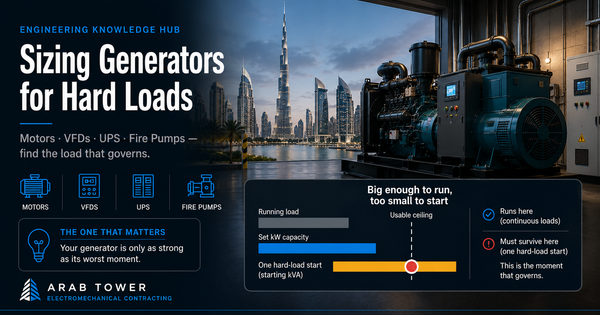
- Allow for motor starting. This is the step most people skip. A big motor — a chiller compressor, a fire pump — pulls six to seven times its running current at the instant it starts. That inrush makes the generator's voltage and frequency dip, and if the dip goes too deep, the set trips or other equipment drops out. Often the single biggest starting load pushes the required size up more than the steady-state load does.
- Add headroom for the future. A 10–20% margin for expansion is sensible — far cheaper than swapping the set out in three years.
- Round up to the next standard frame. Generators come in standard sizes, so our 525 kVA figure, with starting and growth allowance, lands comfortably on a 600–660 kVA standby set.
The UAE factor: derate for heat
Here's the one that catches people sizing off a generic datasheet. Those ratings are usually quoted at reference conditions — often 40°C and sea level. The UAE routinely runs hotter than that, and plant rooms hotter still. As the ambient temperature climbs, both the engine and the alternator lose a few percent of their output — sometimes 5–10% by the time you're at 50°C. If you size right up to the limit on a 40°C rating and then drop the set into a baking rooftop enclosure in July, you've quietly undersized it. Always confirm the rating at your actual site conditions, not the brochure's.
Why standby sets come with heaters
If you're buying a standby generator, you'll notice two items on the spec that don't show up on a prime set running flat out — and they matter far more than they look.
Jacket water heater (block heater). This keeps the engine coolant warm — typically around 40–50°C — while the set sits idle waiting for a mains failure. Why bother in a hot country? Because a cold diesel engine doesn't start cleanly or take full load instantly, and a backup set has to do exactly that. For life-safety systems, codes like NFPA 110 expect the generator to start and accept load within about 10 seconds. A pre-warmed engine starts faster, takes the load step without stumbling, and wears far less than it would on a cold start. Skip it and your "emergency" set becomes a gamble at the worst possible moment.
Alternator anti-condensation heater (space heater). This is a small heating element inside the alternator that runs while the set is switched off. In the UAE's humidity — especially near the coast and overnight — moisture condenses on the alternator windings when the machine is cold and still. That damp lowers the insulation resistance, and the first time the set fires up under load you risk a flashover and a ruined winding. The anti-condensation heater keeps the windings a few degrees above the surrounding air so they stay dry. It's a tiny power draw that quietly protects a very expensive part.
Both of these — along with the battery trickle-charger that keeps the starting batteries topped up — run off the mains while the genset is on standby. That's the whole point: they keep the set permanently ready to go.
The two mistakes we see most
Oversizing "to be safe." A diesel engine that spends its life lightly loaded — below roughly 30% — never gets hot enough to burn its fuel cleanly. Unburnt fuel and soot build up in the exhaust system; it's called wet stacking, and over time it fouls the engine. A right-sized set running at a healthy load is in better shape than a giant set that idles.
Forgetting the biggest motor. Your steady-state maths can say 500 kVA while the fire-pump start says you really need 660. Always check the largest starting load, not just the running total.
In short
Sizing a generator well is part arithmetic, part judgement about how the building actually runs, and part knowing the local conditions that never make it onto a datasheet. We've been sizing, supplying and commissioning gensets across the UAE and internationally for 20+ years, and our KORDEN range runs from 10 kVA up to 2,500 kVA — so we can match the set to the load, rather than the other way round.
If you've got a load schedule, or even a rough connected-load figure, send it over and we'll size it properly — duty, starting loads, derating and all.